Most people never stop to think about this — but “in the street” and “on the street” are not the same thing.
The short answer:
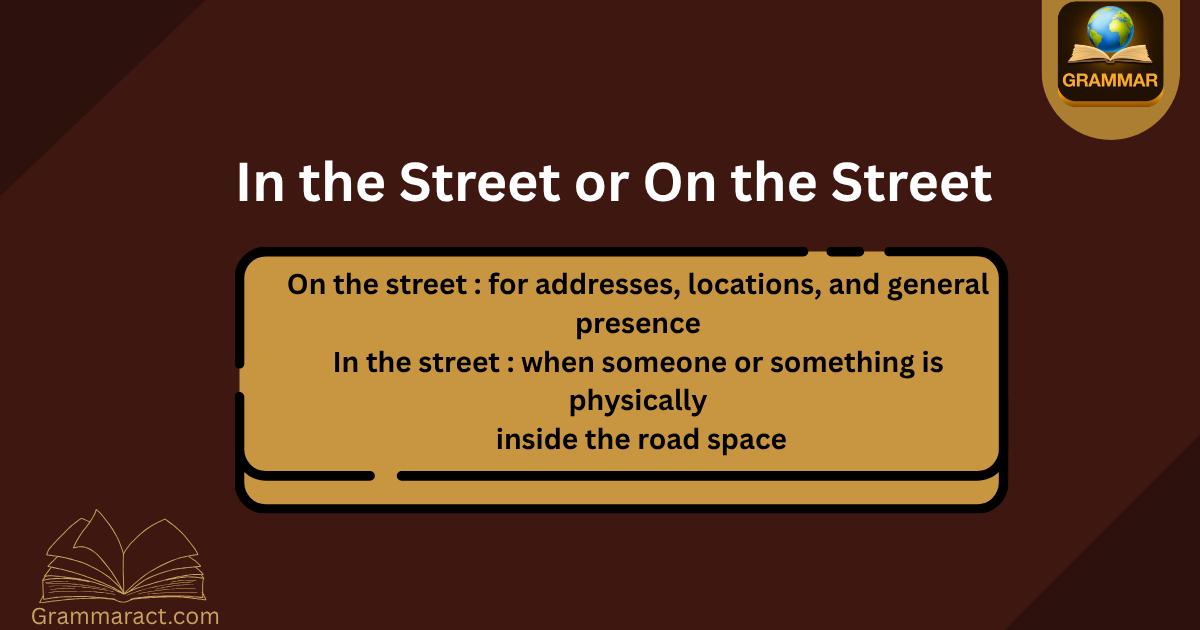
| Phrase | Use Case |
|---|---|
| on the street | for addresses, locations, and general presence |
| in the street | when someone or something is physically inside the road space itself |
They look nearly identical, yet each one carries a distinctly different meaning. One small preposition — two very different pictures.
The Quick Answer – “In the Street” or “On the Street”?
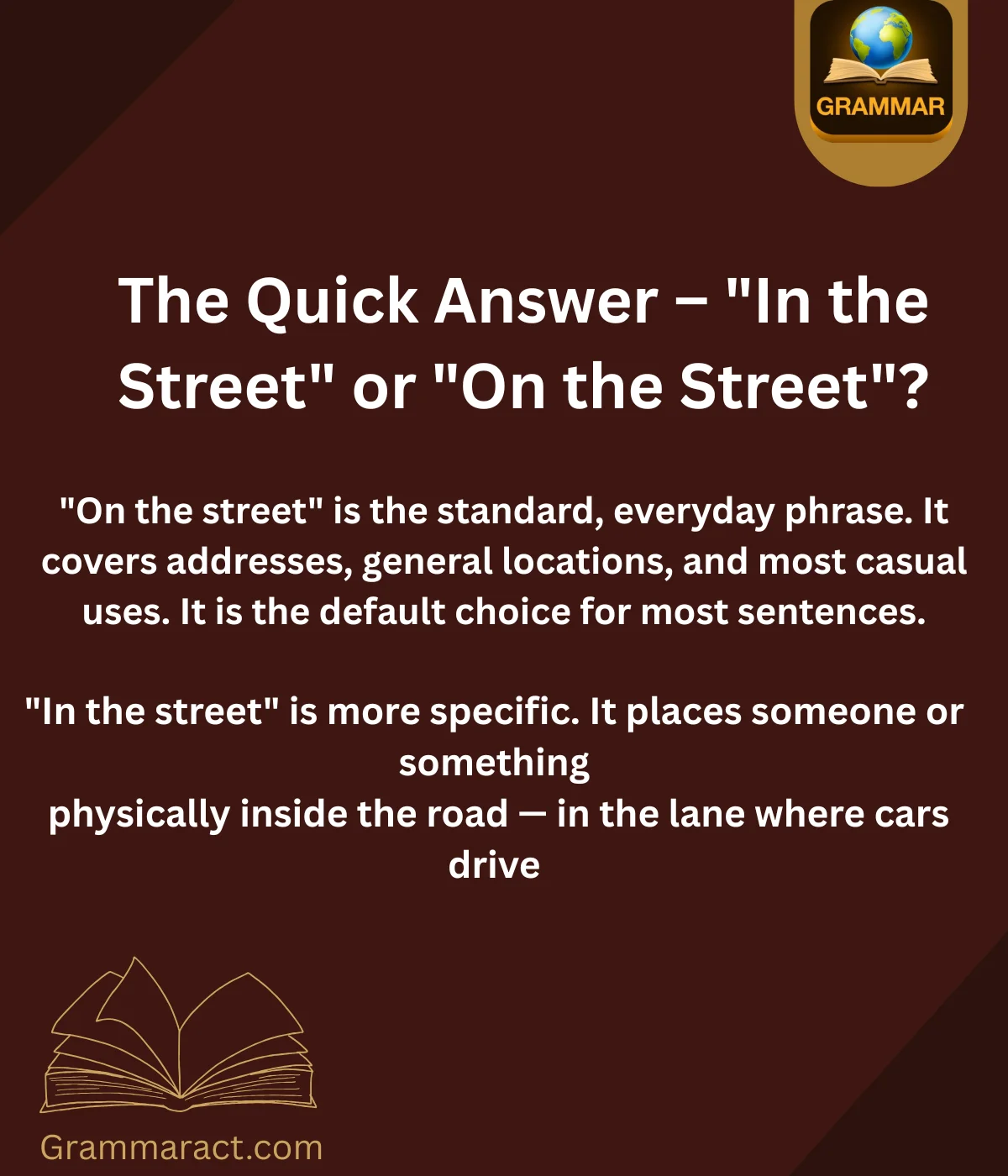
“On the street” is the standard, everyday phrase. It covers addresses, general locations, and most casual uses. It is the default choice for most sentences.
“In the street” is more specific. It places someone or something physically inside the road — in the lane where cars drive. Think of a child running into traffic or a protest filling the roadway. That is “in the street” territory.
When to Say “On the Street” – Rules & Examples
“On the street” treats the street as a surface or location — just like saying something is on a table or on a floor. You are on top of or along it, not inside it.
“On the Street” for Addresses and Locations
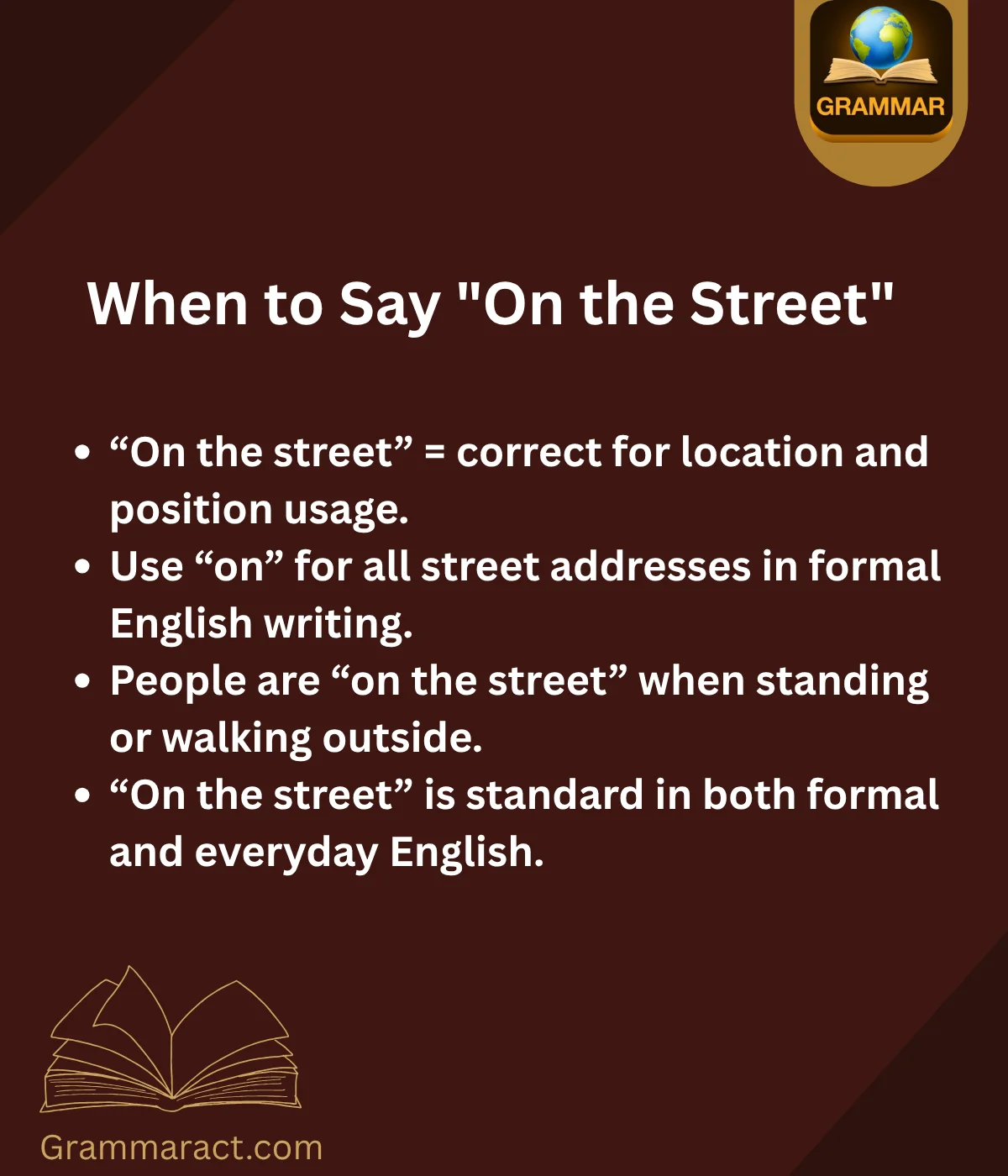
Whenever you give or refer to an address, always use “on.” This is the fixed rule across all standard writing, signage, and formal documentation.
- She lives on Oak Street.
- The office is on Fifth Avenue.
- Turn left — the restaurant is on Main Street.
“On the Street” for Surface-Level Presence
When someone is simply standing, walking, or present alongside a street, use “on.” The street acts as a surface beneath them, the same way a sidewalk or floor would.
- He was standing on the street waiting for a cab.
- She was spotted on the street outside the venue.
“On the Street” in Everyday Conversation
Casual, everyday speech almost always uses “on the street.” Phrases like “I ran into her on the street” or “on the street corner” are natural and idiomatic.
- I heard that rumor on the street.
- He grew up on the streets of Chicago.
📌 Simple Rule: “On the street” = location, address, or surface presence. It is the right choice 90% of the time.
When to Say “In the Street” – Rules & Examples
“In the street” places someone or something inside the road itself — in the lane where vehicles travel. It creates a very specific, often more dramatic, visual.
“In the Street” for Physical Surroundings
Use “in the street” when a person or object is literally surrounded by the road space — not on the sidewalk, but inside the traffic lane.
- A dog ran into the street and caused a crash.
- The children were playing in the street before the cars came.
- There was broken glass in the street after the accident.
“In the Street” for Action or Movement
When describing dramatic action, protest, or movement that fills the road itself, “in the street” is the more vivid and accurate phrase. It signals that the road space is occupied, not just traveled along.
- Thousands marched in the streets after the verdict.
- The protesters flooded into the streets at midnight.
📌 Simple Rule: “In the street” = physically inside the road lane. Use it for danger, drama, or crowd-filling scenarios.
“In the Street” vs “On the Street” – Side-by-Side Comparison
Here is a clear, at-a-glance breakdown of both phrases so you never mix them up again.
| Phrase | When to Use | Example Sentence |
|---|---|---|
| On the Street | Addresses & locations | She lives on Maple Street. |
| In the Street | Inside the road lane | A car stopped in the street. |
| On the Street | General daily presence | He was standing on the street. |
| In the Street | Protests or crowd action | They marched in the streets. |
| On the Street | Casual conversation | I heard it on the street. |
| In the Street | Danger or dramatic scenes | The child ran in the street. |
Memory Trick: Picture “on” as standing on top of a surface — like a sidewalk. Picture “in” as being swallowed by the road itself — surrounded, inside, immersed. That image alone will fix this for good.
Does It Change With Context? – Dancing, Living, Playing
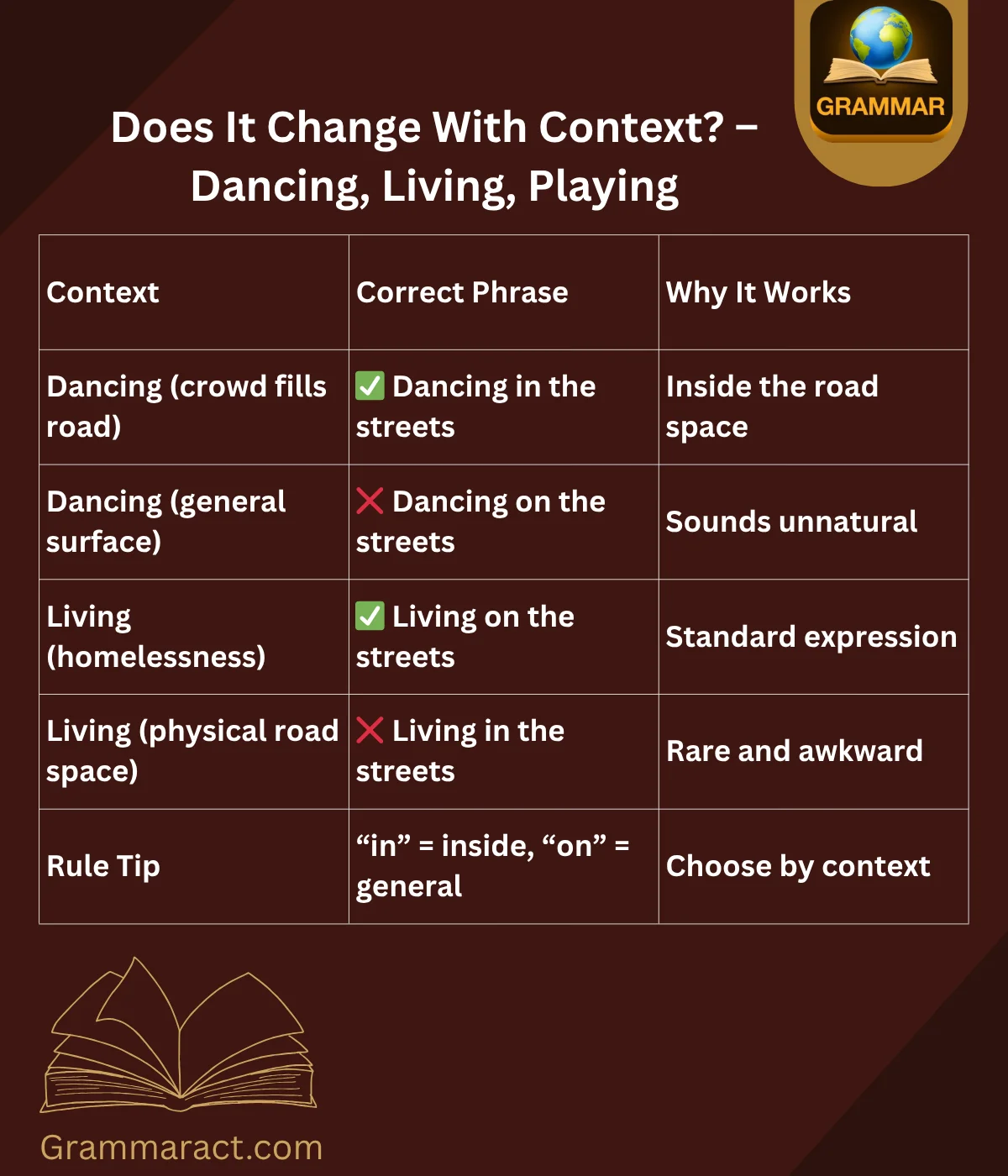
Yes — the verb and context you pair with these phrases changes which preposition is correct. This trips up even experienced writers.
“Dancing in the Streets” or “Dancing on the Streets”?
“Dancing in the streets” is the widely recognized and correct phrase. It implies a celebratory crowd filling the road space — overflowing from sidewalks into the actual lanes. The famous song title confirms this usage.
“Dancing on the streets” sounds awkward and is rarely used. When the action involves the crowd occupying the road itself, “in” is always the more natural and expressive choice.
“Living on the Streets” or “Living in the Streets”?
This one is nuanced. “Living on the streets” is the standard phrase for describing homelessness — it refers to the general condition of living without shelter, using streets as a habitat.
“Living in the streets” is less common and implies being physically confined inside the road space, which sounds unnatural in most contexts. Stick with “on the streets” when discussing homelessness or street life.
FAQ – Your Top Questions Answered
Do you say “in the street” or “on the street”?
Both are correct — in different situations. Use “on the street” for addresses and general presence. Use “in the street” when something is physically inside the road lane.
When to use in the street and on the street?
“On the street” works for locations, addresses, and everyday scenarios. “In the street” is for situations where someone or something is literally inside the road itself.
Which one is correct — on or in?
“On” is correct for most daily uses. “In” is correct when describing physical immersion inside the road. Neither is universally wrong — context decides.
Is it at street or on street?
“At” is used for specific points or intersections: “at the corner of 5th and Main.” For addresses and general street references, always use “on the street.” “At street” alone is not standard.
When to use in the street?
Use “in the street” when describing something physically occupying the road lane — a protest, an accident, a child running into traffic, or debris blocking the road.
Is it dancing in the streets or on the streets?
“Dancing in the streets” is correct. It captures the image of crowds filling and occupying the road space itself during celebrations or events. British and standard usage both agree here.
Is it living on the streets or in the streets?
“Living on the streets” is the standard phrase for describing homelessness or street life. It treats the streets as a general habitat or environment, not a physical enclosure.
Which preposition is used for street?
“On” is the most common preposition used with street — for addresses, locations, and daily language. “In” is used when describing physical presence inside the road. Note: British English uses “in the street” more broadly than standard usage does.
Final Verdict – Which One Should You Use?
When in doubt, go with “on the street.” It covers addresses, locations, casual mentions, and most everyday sentences without any issue.
Only switch to “in the street” when your sentence describes something physically inside the road lane — danger, protest, crowd action, or an object blocking traffic.
The preposition you choose changes the image your reader sees. Choose the one that paints the right picture.
Have a sentence you’re not sure about? Drop it in the comments — we’ll tell you exactly which one to use.

Olivia Smith is the author and admin of GrammarAct, an informational grammar website. She writes clear guides, simple explanations, and helpful lessons to make grammar easy for everyone.