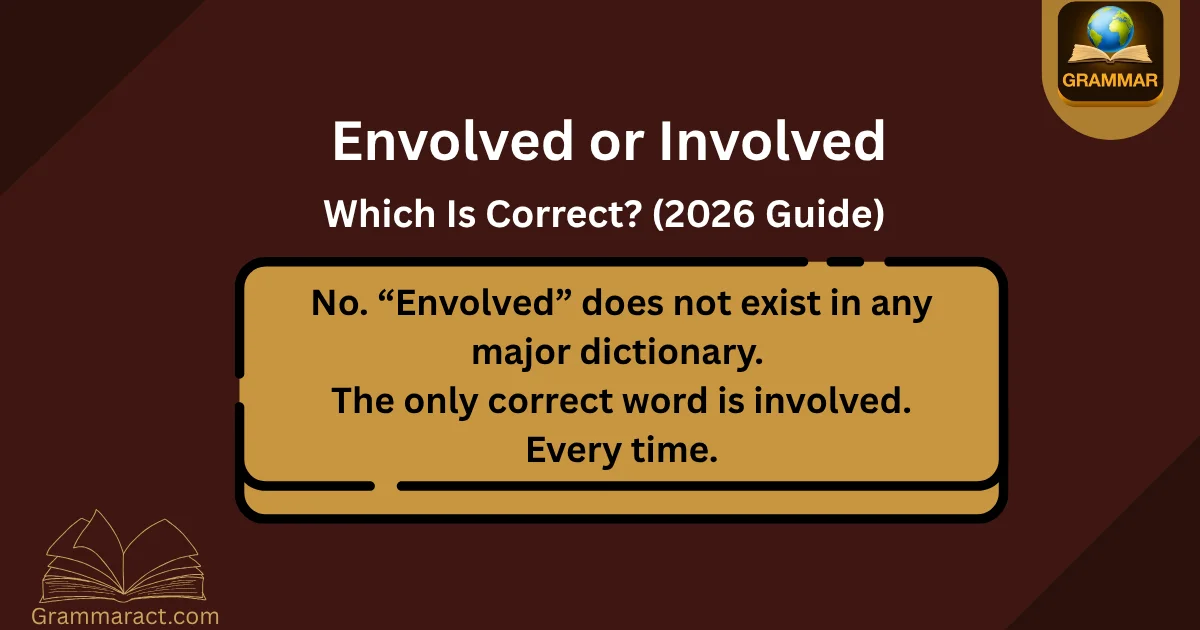
You’ve probably typed “envolved” at least once and wondered — is that even a word?
The short answer:
Whether you’re writing a work email, a school paper, or a social media post — “involved” is always the right choice.
What Does “Involved” Mean? (Definition & Origin)
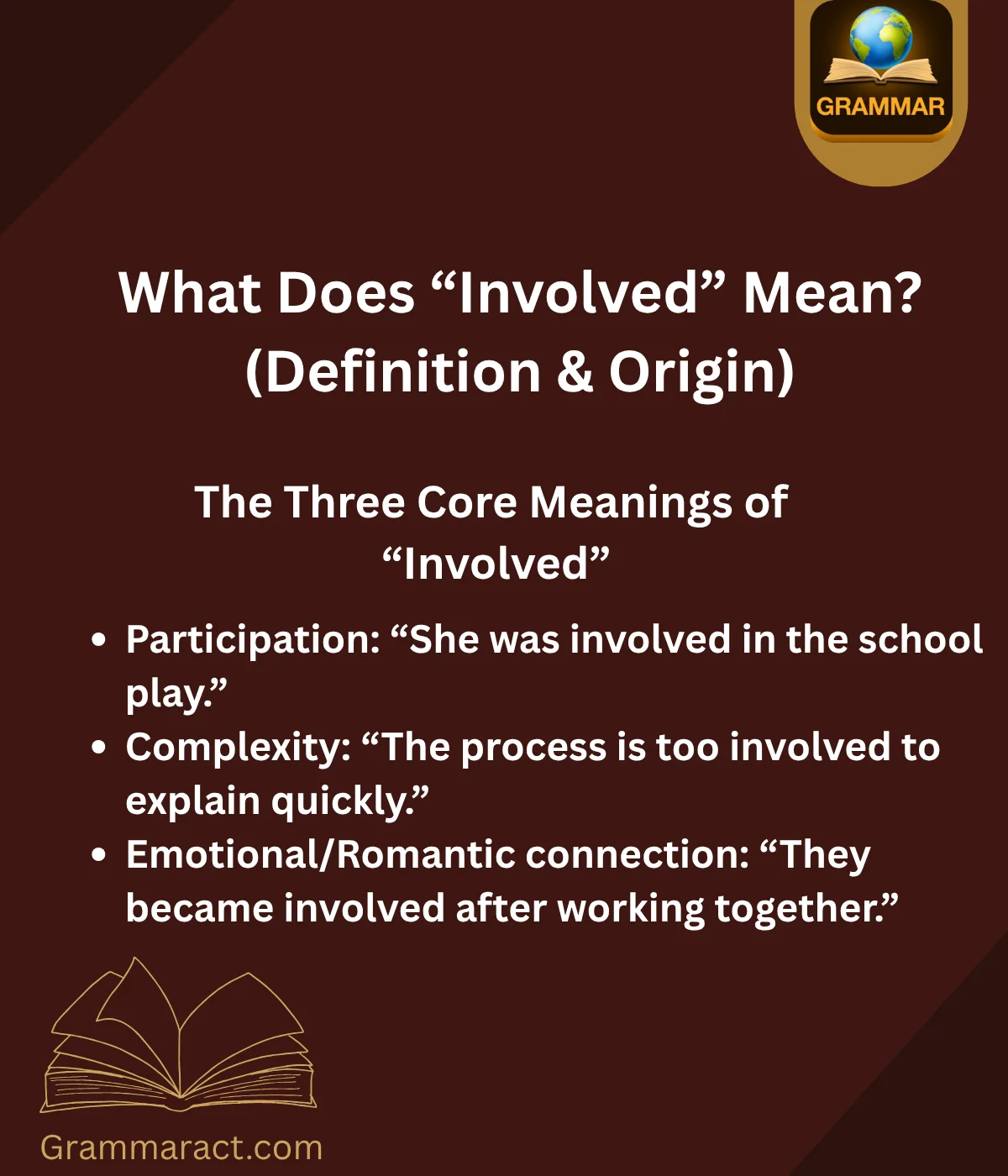
The word involved comes from the Latin involvere, which means “to roll into” or “to entangle.” It entered English in the 14th century and has been standard ever since.
It’s a versatile word. It works as a verb, an adjective, and a past participle. Most people use it every single day without thinking about it.
The Three Core Meanings of “Involved”
- Participation: “She was involved in the school play.”
- Complexity: “The process is too involved to explain quickly.”
- Emotional/Romantic connection: “They became involved after working together.”
| Context | Meaning | Example |
|---|---|---|
| Participation | Being part of an activity or event | She was involved in the school play. |
| Complexity | Something detailed or not simple | The process is too involved to explain quickly. |
| Emotional Connection | Romantic or close personal relationship | They became involved after working together. |
All three meanings share one spelling: I-N-V-O-L-V-E-D. No exceptions.
Where Did the Word “Involved” Come From?
Latin involvere → Old French involver → English involve → past tense: involved.
Notice the pattern: every form starts with “in-”, not “en-”. That’s the key fact to remember.
Is “Envolved” a Real Word? Here’s the Truth
“Envolved” is not a real English word. It doesn’t appear in Merriam-Webster, Oxford, or Cambridge. It has no definition, no history in formal writing, and no place in standard grammar.
Grammar tools like Grammarly, Microsoft Word, and Google Docs all flag it immediately as a spelling error. The fix is always the same — replace it with involved.
Why Do So Many People Write “Envolved”?
This mistake happens for very human reasons:
- Prefix confusion: English has many “en-” words — enclose, engage, ensure, envelop. Writers apply this pattern to “involved” by mistake.
- Phonetic slip: When spoken fast, “involved” can sound like “envolved.” The ear hears “en” where the spelling says “in.”
- Typing habit: A single wrong keystroke — hitting “e” instead of “i” — produces “envolved.” Autocorrect doesn’t always catch it.
- Word confusion: People mix it up with evolved or enveloped, which are real words that look similar.
Why “Envolved” Happens
| Cause | Explanation | Impact |
|---|---|---|
| Prefix Confusion | Words like enclose, engage, and ensure influence spelling patterns | Leads writers to mistakenly use “envolved” |
| Phonetic Slip | Fast speech makes “involved” sound like “envolved” | Causes spelling confusion in writing |
| Typing Error | Simple keyboard mistake (i → e) | Produces incorrect word “envolved” |
| Word Confusion | Mixing with similar words like evolved or enveloped | Results in incorrect usage in sentences |
What the Dictionaries Say About “Envolved”
Here’s the clear record from trusted sources:
| Dictionary | Entry for “Envolved” | Verdict |
|---|---|---|
| Merriam-Webster | Not listed | Not a word |
| Oxford English Dictionary | Not listed | Not a word |
| Cambridge Dictionary | Not listed | Not a word |
| Collins English Dictionary | Not listed | Not a word |
The verdict is unanimous. “Envolved” does not exist in standard English.
Envolved or Involved – How to Use “Involved” Correctly in a Sentence
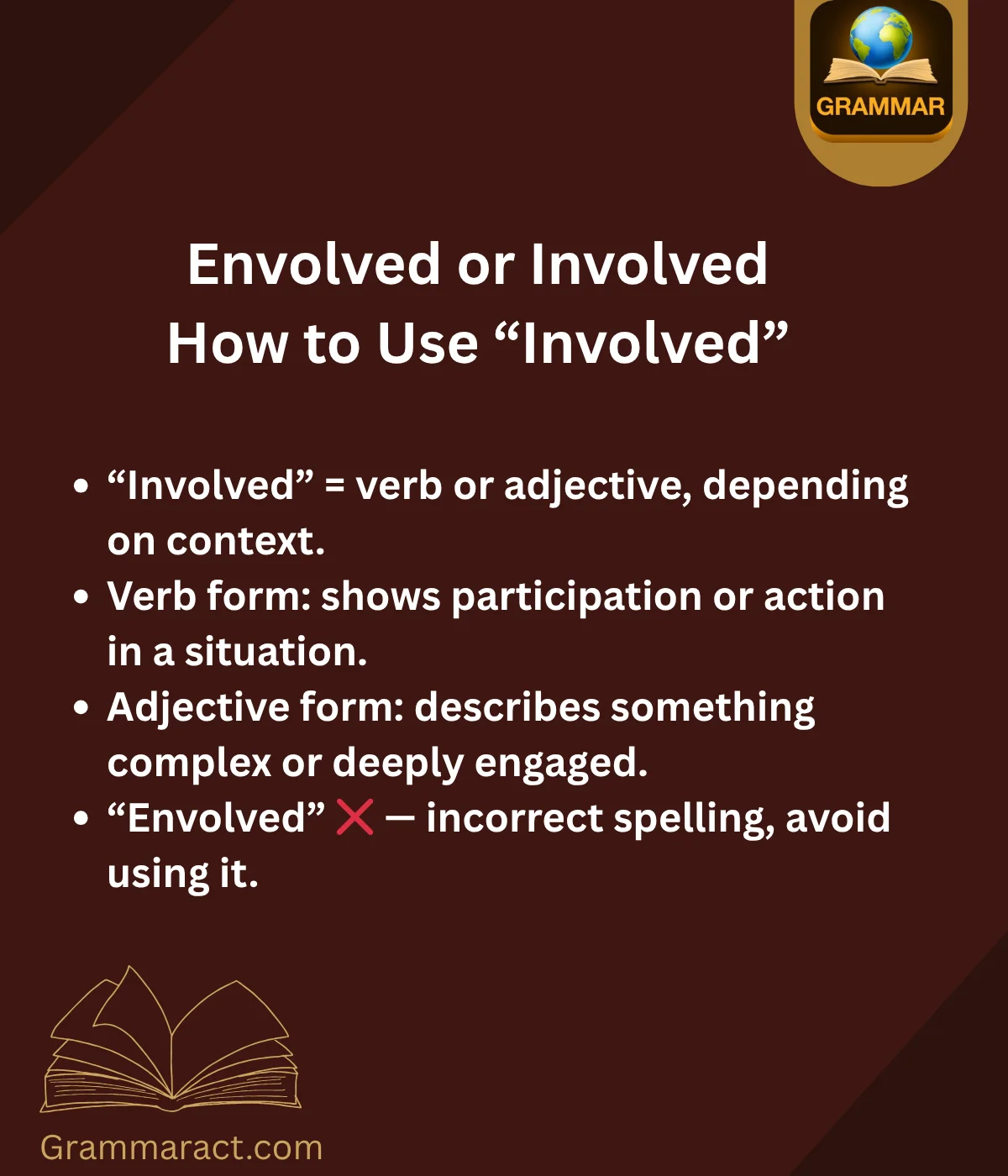
Involved functions as both a verb and an adjective. Knowing which role it’s playing helps you use it with confidence.
“Involved” as a Verb (Past Participle)
Use it to describe an action in the past or a passive construction:
- ✅ The project involved three departments.
- ✅ She was involved in planning the event.
- ✅ Several witnesses were involved in the case.
- ❌ Wrong: He was envolved in the merger.
“Involved” as an Adjective
Use it to describe something complex or someone who is deeply engaged:
- ✅ This is a very involved process.
- ✅ She has an involved role in the organization.
- ❌ Wrong: The instructions were too envolved to follow.
Correct vs. Incorrect Example Sentences
| Incorrect (Envolved) | Correct (Involved) |
|---|---|
| He was envolved in the project. | He was involved in the project. |
| She got envolved with charity work. | She got involved with charity work. |
| Are you envolved in this? | Are you involved in this? |
| The process is too envolved. | The process is too involved. |
| They became envolved last year. | They became involved last year. |
Involved vs. Evolved vs. Enveloped – Know the Difference
These three words look and sound similar. That’s exactly why writers confuse them. Here’s a quick breakdown:
Quick Comparison Table
| Word | Meaning | Example |
|---|---|---|
| Involved | Participated in / connected to / complex | She was involved in the decision. |
| Evolved | Changed or developed gradually over time | The species evolved over millions of years. |
| Enveloped | Wrapped or covered completely | The fog enveloped the entire city. |
| Envolved | Does not exist | Never use this word. |
The trick: involved = participation, evolved = change over time, enveloped = wrapped around. Three different words with three different meanings.
Easy Memory Tricks to Never Misspell “Involved” Again
One simple trick covers it all: when you’re involved in something, you’re IN it. The word literally starts with “in” because it means being inside or part of something.
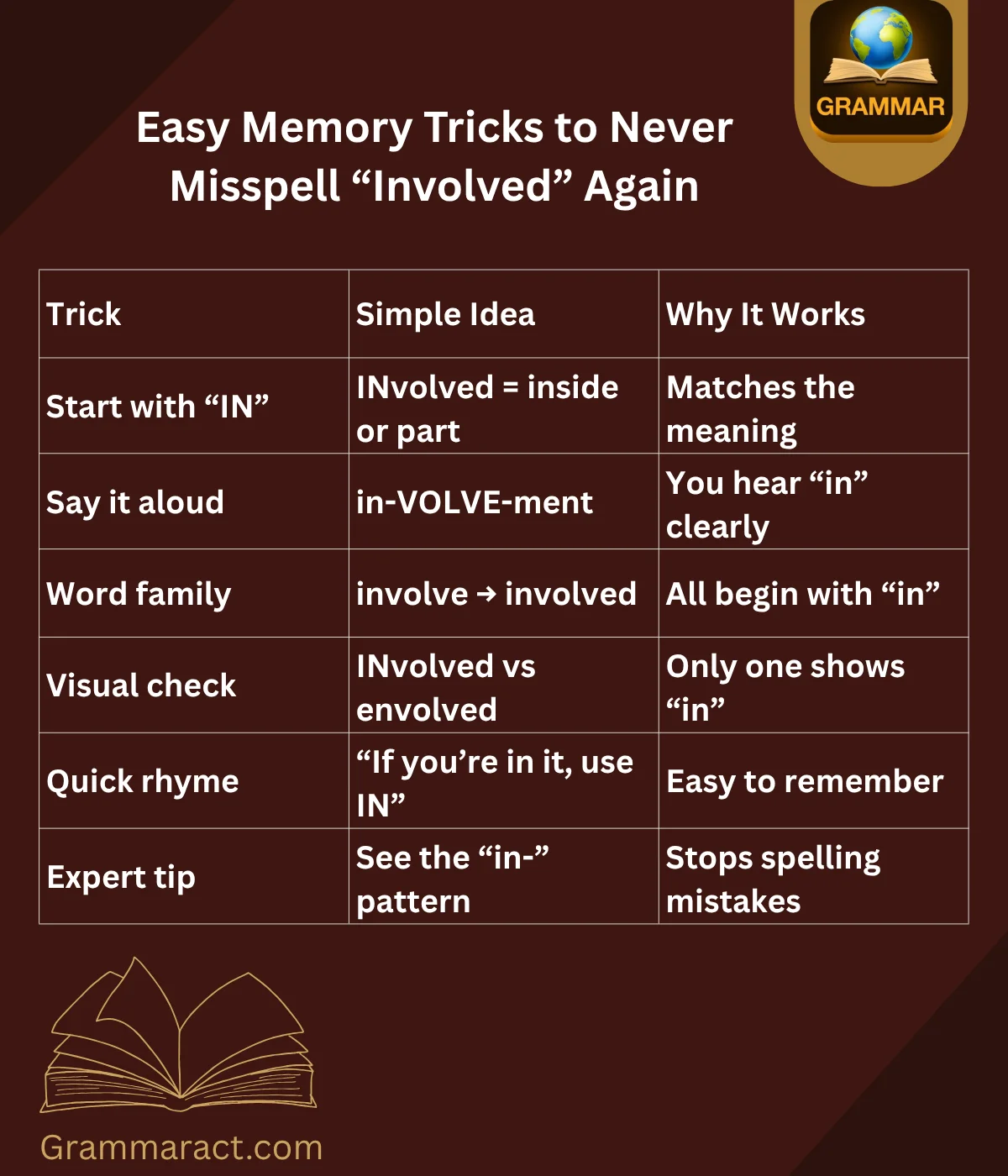
More tricks that work:
- Say “involvement” out loud. You clearly hear “in-VOLVE-ment.” That same “in” is at the start of “involved.”
- Think of the word family: involve → involves → involving → involvement → involved. All start with “in.”
- The “in” is visible inside “involved.” Look: INvolved. Can’t see “in” in “envolved.”
- Quick rhyme: “If you’re part of it, you’re IN it.”
According to writing coaches, once a writer clearly sees the “in-” prefix pattern, they virtually never misspell it again. The connection between meaning and spelling locks it in.
Synonyms of “Involved” You Can Use Instead
Sometimes you need a different word to avoid repetition. Here are strong alternatives depending on your context:
| Context | Synonym Options |
|---|---|
| Participation | engaged, included, participating, connected, active |
| Complexity | intricate, complicated, elaborate, complex, detailed |
| Emotional connection | invested, committed, attached, devoted, entangled |
| Legal/professional | implicated, associated, linked, tied to, part of |
These synonyms are all valid in standard usage. Pick the one that fits your tone — engaged works well in professional writing, while entangled has a more dramatic, literary feel.
FAQs – Envolved or Involved
What is the difference between involved and envolved?
Involved is a real, standard English word meaning to participate in or be connected to something. Envolved is not a word at all — it’s a common misspelling caused by prefix confusion. Always use involved.
When to use involve?
Use involve (present tense) when describing an action that includes or requires something: “This task will involve teamwork.” Use involved for past actions or as an adjective: “She was involved in the project.”
What is the definition of envolved?
“Envolved” has no definition because it doesn’t exist. It’s not in Merriam-Webster, Oxford, or Cambridge. If you see it in writing, it’s always a spelling error for involved.
Is “got involved” correct?
Yes, completely. “Got involved” is a natural, standard phrase: “She got involved in the project last month.” It’s used in both formal and informal writing without any issues.
What are the synonyms of envolved?
Since “envolved” isn’t a real word, look for synonyms of involved instead: engaged, included, participating, connected, committed, implicated, or associated, depending on context.
How do you use “involved” in a sentence?
Here are three quick examples across different uses:
- “He was involved in the accident investigation.” (participation)
- “The instructions were far too involved for beginners.” (complexity)
- “They became romantically involved after the trip.” (emotional connection)
Conclusion
The answer is simple: always use “involved.” The word “envolved” has never existed in standard English and never will.
Remember: if you’re part of something, you’re IN it. That“in” is built right into the spelling. Spot it once, remember it always. Your writing will be cleaner, more credible, and completely error-free.

Olivia Smith is the author and admin of GrammarAct, an informational grammar website. She writes clear guides, simple explanations, and helpful lessons to make grammar easy for everyone.