| “First priority” is grammatically correct |
| and widely accepted in standard English. |
While some grammar purists call it redundant — since “priority” already implies importance — the phrase adds emphasis, urgency, and clarity that “priority” alone sometimes lacks.
What Does “First Priority” Actually Mean?
The word priority comes from the Latin prioritas, meaning “the condition of being earlier or more important.” It refers to something that ranks above other things in urgency or importance.
When you say “first priority”, you’re stressing the top item on that ranked list. It signals: this comes before everything else. No ambiguity. No second-guessing.
Is “First Priority” Grammatically Correct or Redundant?
Strictly speaking, “first priority” is technically redundant. Since “priority” already means “the most important thing,” adding “first” repeats that idea.
But redundancy in English isn’t always wrong. It often serves a purpose — emphasis, rhythm, and clarity. Think of phrases like “end result” or “future plans.” Redundant? Yes. Useful? Absolutely.
What do major style guides say?
| Authority | Stance on “First Priority” |
|---|---|
| Chicago Manual of Style | Discourages redundancy but accepts it for emphasis. |
| APA Style | Prefers concise language; allows it if clarity improves. |
| Merriam-Webster | Widely used in real-world English. |
| Bryan Garner | Redundancy can strengthen meaning. |
When Should You Use “First Priority” — And When to Avoid It?
When It Works Perfectly
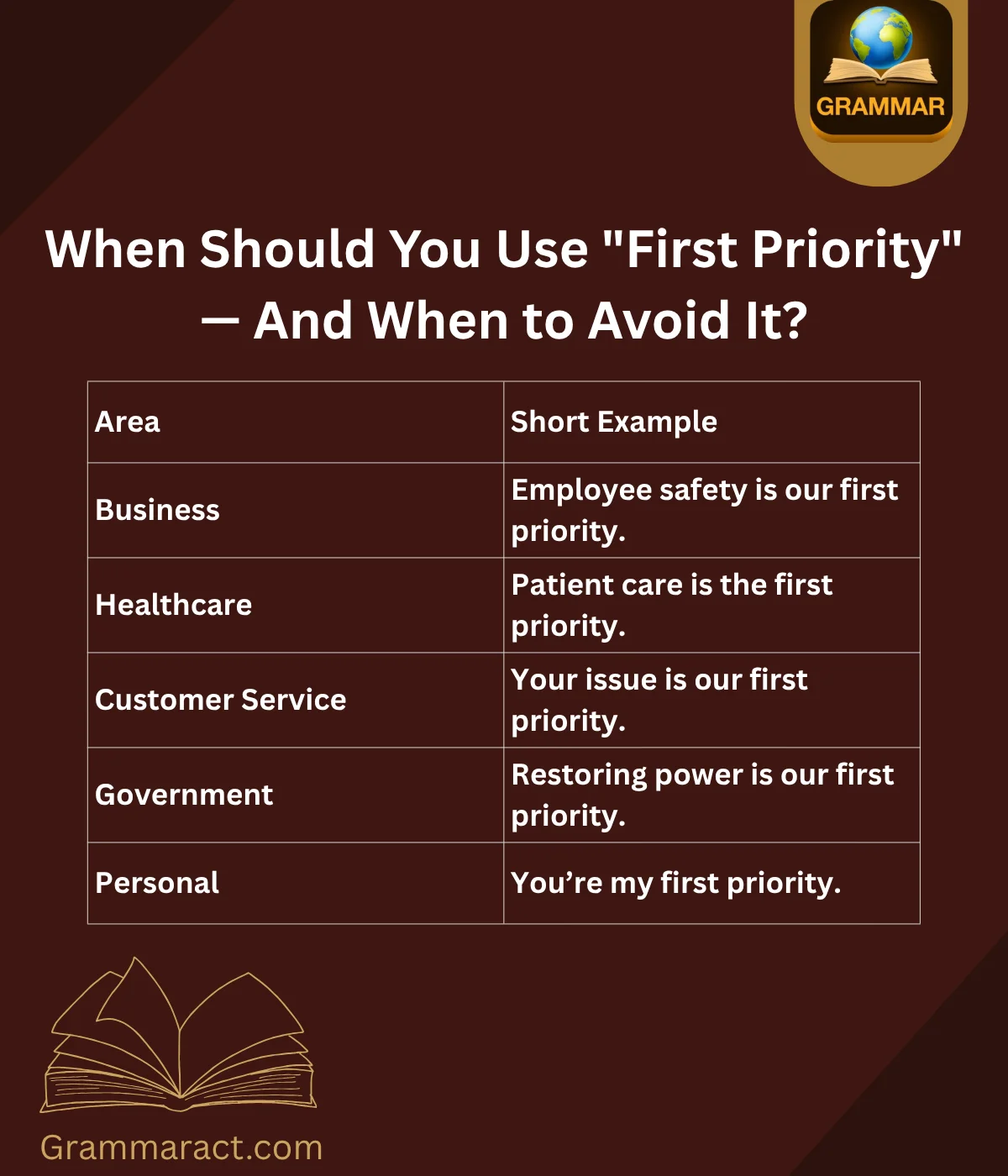
Use “first priority” when you need to cut through noise and signal urgency. These are the moments where the phrase earns its place:
- Business & Corporate: “Employee safety is our first priority.”
- Healthcare: “Patient care is the first priority of every nurse on this floor.”
- Customer Service: “Resolving your issue is our first priority.”
- Government: “Restoring power after the storm is our first priority.”
- Personal communication: “You’re my first priority — nothing else comes close.”
When to Avoid It
In academic papers, legal documents, and technical writing, precision beats emphasis. Readers in these spaces expect tight, efficient language.
If the context already makes urgency clear, adding “first” can feel redundant without adding value. In those cases, “top priority” or “primary concern” often reads cleaner.
What’s Another Word for “First Priority”?
Sometimes you want the same weight without the redundancy. Here are strong, high-impact alternatives you can swap in depending on context:
| Phrase | Tone | Best Used In |
|---|---|---|
| Top priority | Strong, clear | Business, formal writing |
| Primary concern | Professional, precise | Reports, proposals |
| Main focus | Neutral, conversational | Emails, meetings |
| Leading objective | Formal, strategic | Mission statements |
| Most urgent task | Direct, action-driven | Project management |
| Chief concern | Formal, authoritative | Legal, government |
How to Use “Priority” and “First Priority” Correctly in a Sentence
Seeing these phrases in real sentences is the fastest way to get comfortable with them. Here are 10 practical examples across different contexts:
- 1. “Safety is our first priority on every job site.”
- 2. “My first priority this week is finishing the project report.”
- 3. “Customer satisfaction remains a priority for every department.”
- 4. “The board made it clear: cost-cutting is the first priority this quarter.”
- 5. “For parents, a child’s health is always a top priority.”
- 6. “Restoring access to clean water is the first priority after a disaster.”
- 7. “Our first priority is hiring qualified teachers, not buying new equipment.”
- 8. “She told her team: client communication is the first priority.”
- 9. “In crisis situations, speed of response is a priority, not perfection.”
- 10. “His first priority after relocating was finding reliable childcare.”
Frequently Asked Questions
Is it correct to say first priority?
Yes. “First priority” is grammatically acceptable and widely used. It may be technically redundant, but it adds clarity and emphasis that plain “priority” sometimes doesn’t deliver.
What does first priority mean?
It means the most important task or concern — the one that comes before all others in terms of urgency, attention, or action.
What’s another word for first priority?
Strong alternatives include top priority, primary concern, main focus, chief objective, and leading task. Each carries slightly different weight depending on context.
How can I use priority in a sentence?
Here’s a quick example: “My priority this morning is responding to client emails before the team meeting.” Simple, clear, and natural.
What can I say instead of “priority”?
Try concern, focus, objective, goal, emphasis, or urgency. The best substitute depends on what tone you need — formal, casual, or action-oriented.
What is an example of a first priority?
In a hospital: “Stabilizing the patient is the first priority before any other procedure.” It leaves no doubt about what happens first.
What does “you’re my first priority” mean?
It means someone places your needs, wellbeing, or happiness above everything else in their life. It’s a strong personal statement of commitment and care.
Does priority mean first?
Yes — by definition. The word priority comes from the Latin prior, meaning “before.” It already implies ranking, which is why some see “first priority” as repetitive.
What is the first priority in life?
This varies by person, but research in psychology consistently points to health, meaningful relationships, and financial stability as the most commonly cited life priorities. (Note: British English sometimes uses “prioritise” vs. the standard spelling “prioritize” — both are correct in their respective regions.)
Final Verdict — Should You Say “First Priority”?
“First priority” is correct. It’s not a grammar mistake — it’s a deliberate emphasis tool. Use it when you need to stress what matters most, especially in business, public communication, or emotionally weighted conversations.
If you’re writing for an academic journal or tight, minimalist copy, swap it for “top priority” or “primary concern.” But in everyday communication, “first priority” is clear, natural, and effective. Language serves people — not the other way around.

Olivia Smith is the author and admin of GrammarAct, an informational grammar website. She writes clear guides, simple explanations, and helpful lessons to make grammar easy for everyone.