Have you ever paused mid-sentence and asked yourself — is it input or imput? You’re not alone. Millions of people type this word every single day and still second-guess the spelling.
Here’s the clear answer:
| Word | Status |
|---|---|
| “Input” | is correct |
| “Imput” | does not exist in any English dictionary not Merriam-Webster, not Oxford, not Cambridge. It has never been a real word. |
Every time you see “imput,” you’re looking at a typo or phonetic mistake. That’s it.
What Do Input and Imput Actually Mean?
What Is the Correct Spelling of Input?
Input is a standard English word that has been in use since around 1888. It comes from two simple words combined: “in” + “put” — meaning to put something in. That’s where the spelling comes from, and that’s why it will never change.
It works as both a noun (your input on the meeting) and a verb (please input your password). Both Merriam-Webster and Oxford Dictionary confirm this as the only correct form.
What Is an Imput – Does It Even Exist?
No. “Imput” is not a word. It is not listed in any major dictionary or recognized by any style guide — including the Chicago Manual of Style, APA, or MLA. There is no British variant, no regional usage, and no historical record of it ever being correct.
If you’ve typed “imput” before, don’t worry. It’s one of the most common phonetic spelling errors in written English. The fix is simple: always use input.
Why Do So Many People Write Imput Instead of Input?
The confusion isn’t random. There are real linguistic and mechanical reasons behind this common misspelling.
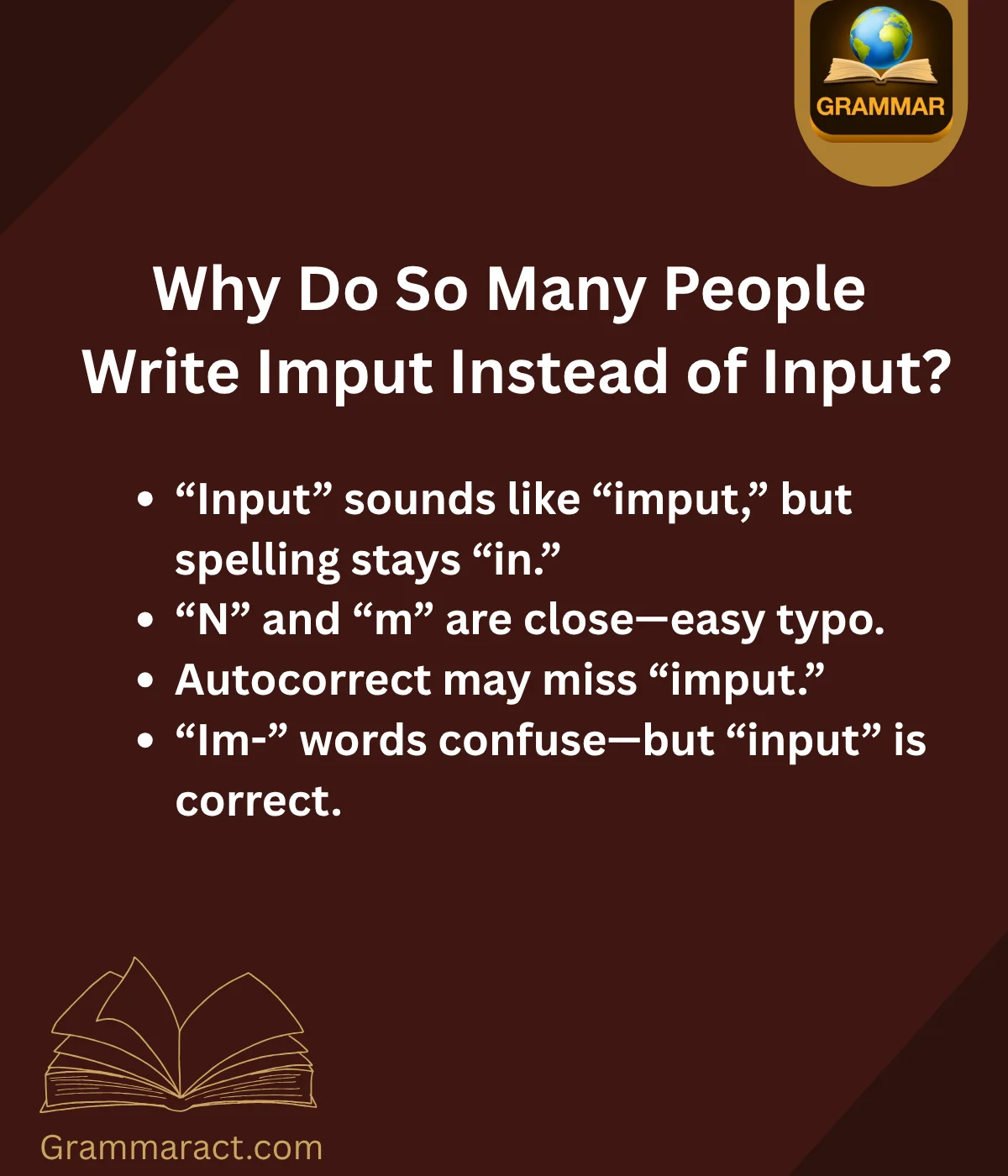
- Phonetic assimilation: When spoken fast, the “n” in “input” shifts naturally to an “m” sound before the “p.” So it sounds like “im-put” even though it’s spelled “in-put.”
- Keyboard proximity: The letters “n” and “m” sit right next to each other. A single finger slip creates the error instantly.
- Autocorrect failures: Some older devices and apps fail to flag “imput” as wrong, letting the mistake slip through unnoticed.
- Confusion with similar words: “Imply,” “import,” and “impute” all start with “im-” — and that prefix bleeds into the spelling of “input” by mistake.
- ESL influence: In regions where English is a second language, “imput” appears frequently because speakers write what they hear.
How to Use Input Correctly in a Sentence
Input as a Noun — Meaning and Examples
As a noun, input means a contribution — data, feedback, ideas, or energy entered into a process or system.
- “Your input on this project has been incredibly valuable.”
- “We need more user input before we finalize the design.”
- “The teacher welcomed student input during the discussion.”
The plural form is simple: inputs. Example: “All inputs were recorded before the system launched.”
Input as a Verb — Meaning and Examples
As a verb, “input” means to enter information into a system or device.
- “Please input your password to continue.”
- “She spent the morning inputting data into the spreadsheet.”
- “The engineer will input the final values before testing.”
For past tense, standard usage prefers “input” (not “inputted”), though “inputted” is acceptable in British English.
How Does Imput Differ from Input?
It doesn’t — because “imput” has no meaning. The only difference is that one is correct and one is a mistake. See the comparison below:
| Word | Correct? | Meaning | Example |
|---|---|---|---|
| input | ✅ Yes | Data, feedback, or contribution entered into a system | “Your input was helpful.” |
| imput | ❌ No | Not a word — misspelling of input | Never use this form |
| impute | ✅ Yes | To assign blame or credit to someone | “She imputed the error to bad data.” |
Input vs. Impute – Do Not Confuse These Two
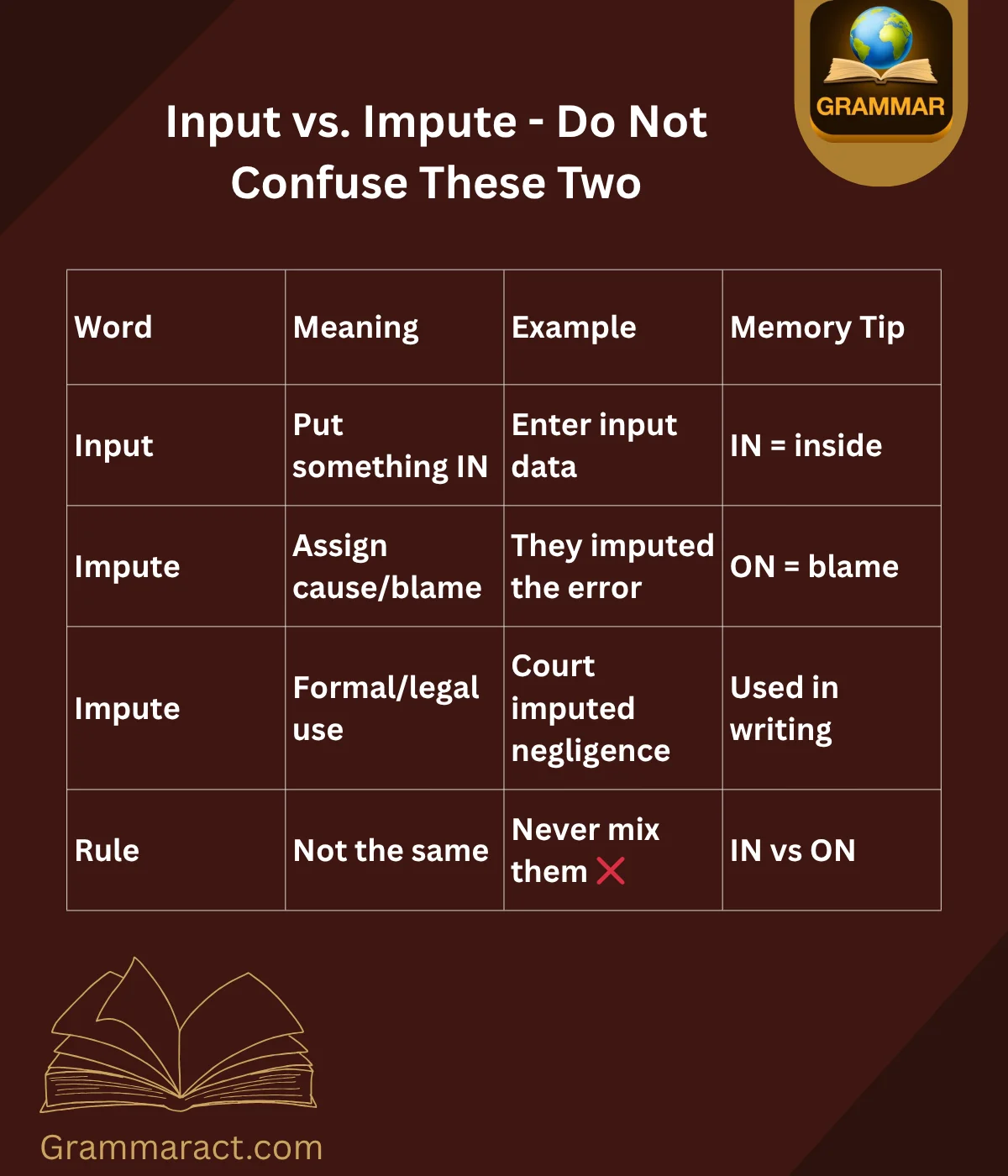
This is where things get interesting. Impute is a real English word — but it means something completely different from “input.”
Impute means to attribute or assign a cause, action, or blame to someone. It is most commonly used in legal, moral, and academic writing.
- “The court could not impute negligence without clear evidence.”
- “You cannot impute your beliefs onto someone else.”
- “The success was imputed to the team’s consistent effort.”
Synonyms for impute: attribute, assign, ascribe, credit, charge, blame.
Quick memory rule: Input = put something IN. Impute = pin something ON someone. Two completely different words.
What Are Examples of Input? Real-World Usage by Context
The word input is one of the most versatile terms in English. It’s used across technology, education, economics, and everyday conversation.
| Context | Example Sentence |
|---|---|
| Technology | “The system requires keyboard input to launch the program.” |
| Business | “Your input on the Q3 strategy was genuinely valuable.” |
| Education | “Student input helps teachers improve their lesson plans.” |
| Economics | “Labor and capital are the primary inputs for production.” |
| Casual | “I’d love your input on which restaurant we should try.” |
Notice how input works naturally in every single context — from coding to casual conversation. “Imput” would look wrong in every one of these sentences.
FAQ — Input or Imput: Your Questions Answered
What is an imput?
“Imput” is not a real English word. It is a misspelling of “input” caused by phonetic confusion or a keyboard slip. Never use it in writing.
What is the correct spelling of input?
The correct spelling is always input — I-N-P-U-T. No dictionary recognizes any alternative. Both British and American English use the same spelling.
What is an example of impute?
“The court could not impute blame to either party without sufficient evidence.” Impute means to attribute responsibility or credit to someone — completely different from input.
How does imput differ from input?
“Imput” has no definition because it isn’t a word. “Input” is the only valid form — in formal, casual, technical, and academic writing.
What is another word for impute?
Common synonyms: attribute, assign, ascribe, credit, charge, blame. Example: “The manager attributed the delay to supply chain issues.”
What does impute mean in one word?
Attribute. To impute something is to assign it to a cause or a person.
How to use input in a sentence?
As a noun: “Your input on the proposal was exactly what we needed.” As a verb: “Please input your details to complete the form.”
What are examples of input?
Data typed into a computer, feedback given in a meeting, user suggestions, resources used in production, ideas contributed in a brainstorming session.
Does input have a plural?
Yes. The plural is inputs. Example: “All system inputs were verified before launch.”
Conclusion – Always Use Input, Never Imput
There is no gray area here. “Input” is correct. “Imput” is always wrong. Whether you’re writing an email, filling out a form, or drafting a professional report — the spelling never changes.
The simplest trick to remember it: IN + PUT = INPUT. You put something in. That’s the word. That’s the spelling.
One letter makes the difference between sharp, professional writing and an instant credibility hit. Always choose input.

Olivia Smith is the author and admin of GrammarAct, an informational grammar website. She writes clear guides, simple explanations, and helpful lessons to make grammar easy for everyone.