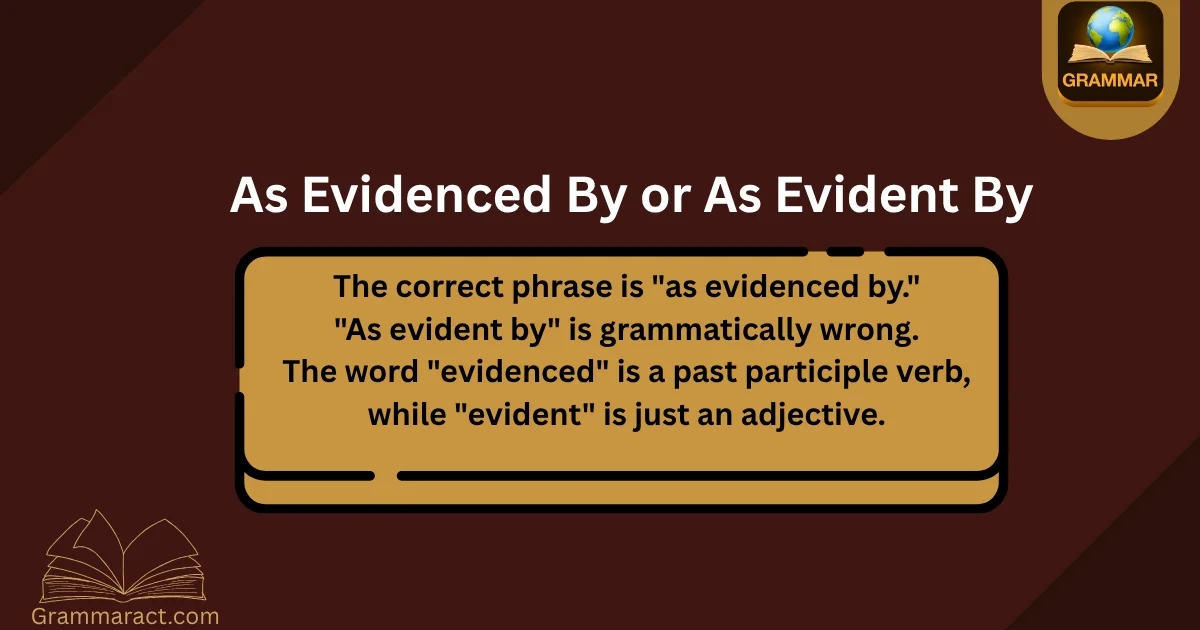
The correct phrase is “as evidenced by.” “As evident by” is grammatically wrong. The word “evidenced” is a past participle verb, while “evident” is just an adjective — and adjectives cannot pair with “by” to form a passive clause.
This is one of the most misused phrases in professional and academic writing. Understanding the difference will sharpen your writing instantly — and protect your credibility.
What Does As Evidenced By Actually Mean?
The Grammar Behind the Phrase: Verb vs. Adjective
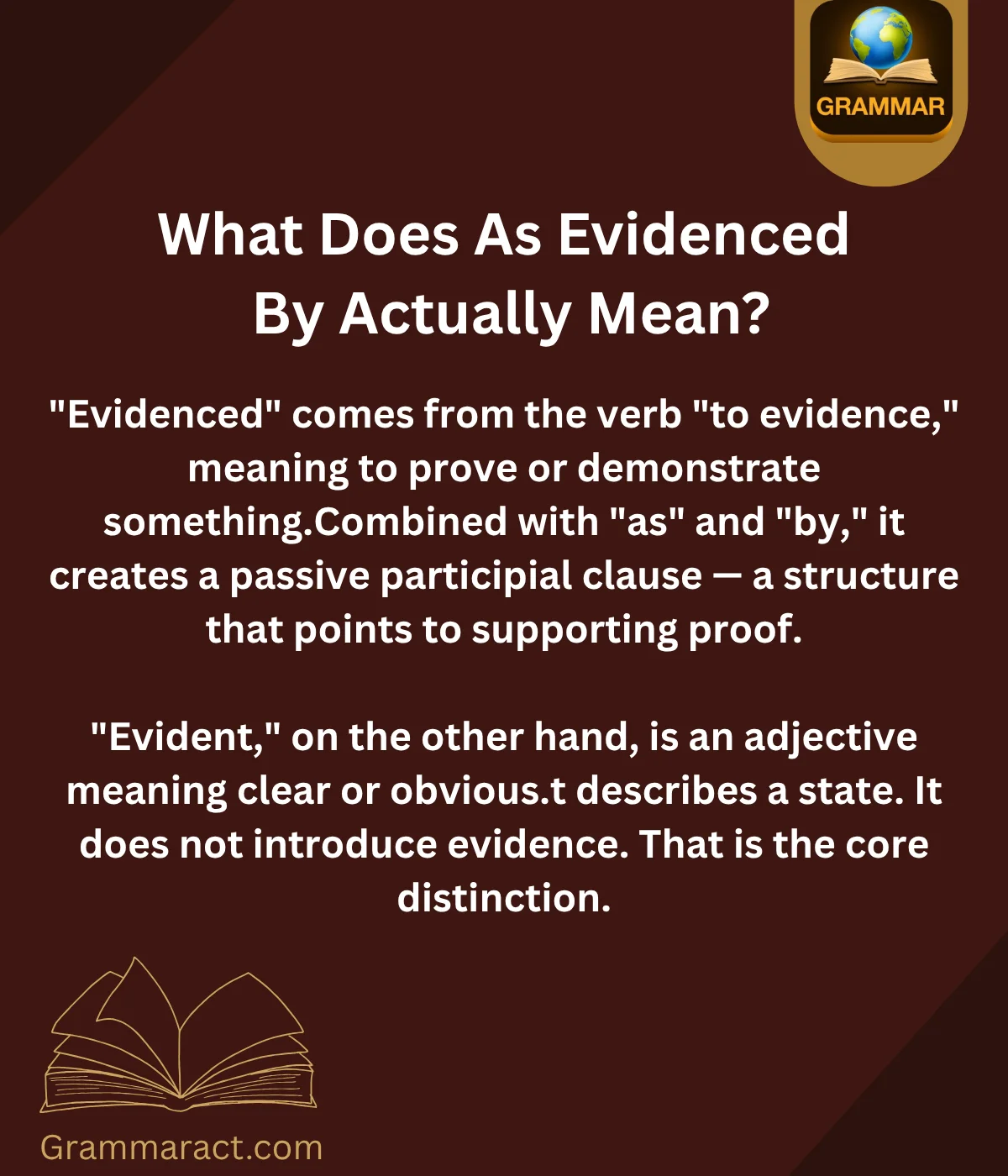
“Evidenced” comes from the verb “to evidence,” meaning to prove or demonstrate something. Combined with “as” and “by,” it creates a passive participial clause — a structure that points to supporting proof.
“Evident,” on the other hand, is an adjective meaning clear or obvious. It describes a state. It does not introduce evidence. That is the core distinction.
Why As Evident By Is Grammatically Incorrect
Adjectives in English cannot take “by” to show proof. Writing “as evident by the results” leaves the clause incomplete — the implied verb is missing.
Think of it this way: “as evident by” is like using a wrench to hammer a nail. It looks close, but the tool is simply wrong for the job.
The One Exception: When Evident Can Work
If you want to use “evident,” the correct form is “as is evident from.” The linking verb “is” makes the adjective grammatically complete. Note also that the preposition shifts from “by” to “from.”
✅ Correct: “The results are strong, as is evident from the data.”
Quick Comparison Table
| Phrase | Correct? | Example |
|---|---|---|
| as evidenced by | Yes | …as evidenced by the data |
| as evident by | No | …as evident by the data |
| as is evident from | Yes | …as is evident from the chart |
How to Use As Evidenced By in a Sentence
Correct Usage in Academic Writing
In academic writing, “as evidenced by” links a claim directly to its proof. It is standard in journals, research papers, and dissertations.
✅ “The intervention proved effective, as evidenced by a 40% reduction in symptoms across all trial groups.”
Correct Usage in Business and Professional Writing
Business reports rely on this phrase to back up conclusions with hard data. It signals that your statement is rooted in verifiable proof, not opinion.
✅ “Customer satisfaction improved, as evidenced by our Net Promoter Score rising from 34 to 71 this quarter.”
Common Mistakes to Avoid
- Using “as evident by” instead of “as evidenced by” ❌
- Attaching the phrase to the wrong subject (dangling modifier)
- Overusing the phrase — vary your language to improve readability
- Writing “as evidenced by completing the task” — no clear noun to attach to
Evidenced In vs. Evidenced By: Is There a Difference?
When to Use Evidenced By
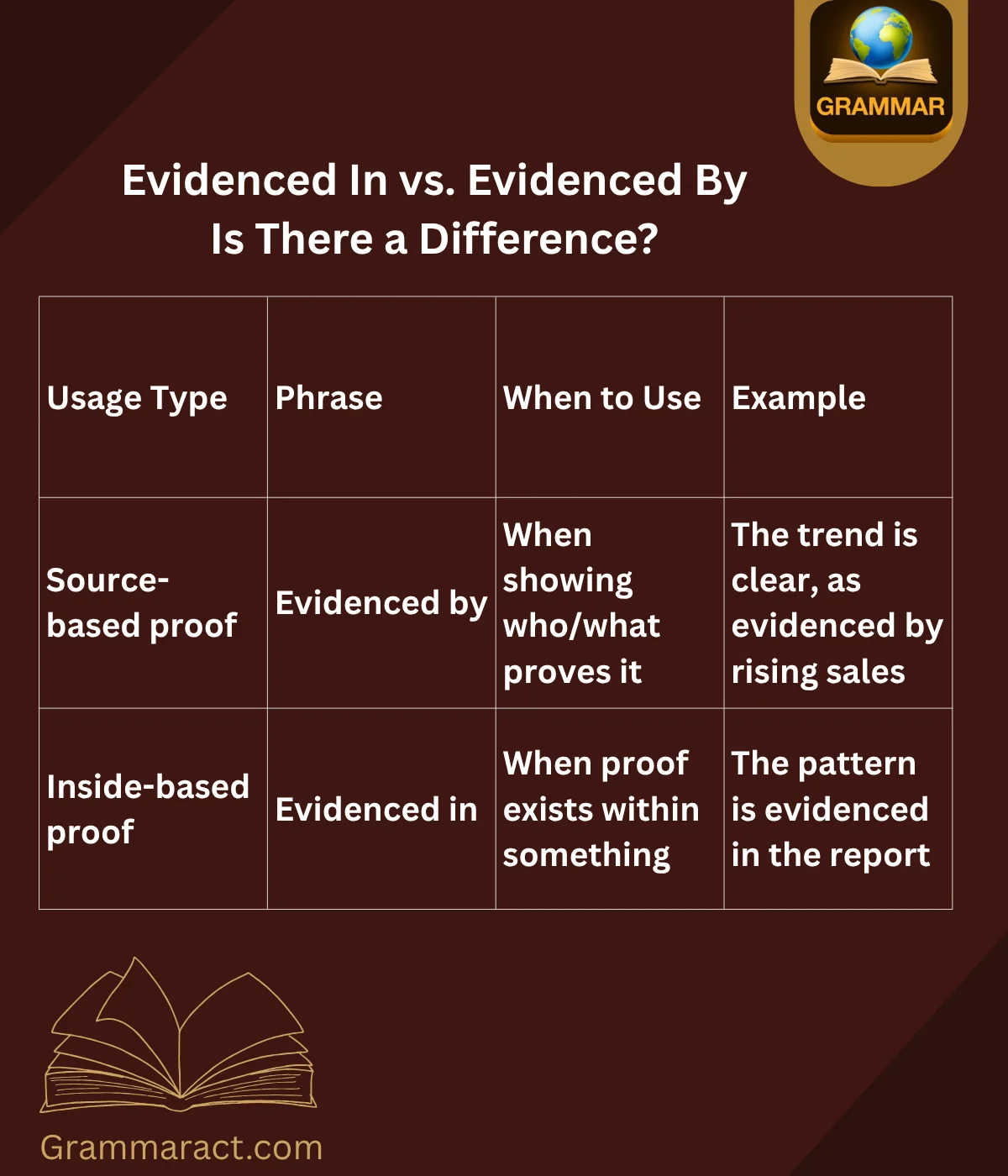
Use “evidenced by” when pointing to a specific source or agent validating your claim. “By” introduces the proof-giver.
✅ “The trend is clear, as evidenced by three consecutive years of rising sales.”
When Evidenced In Works
“Evidenced in” is used when proof exists within something — a report, dataset, or document — rather than as an active proof-source.
✅ “This pattern is evidenced in the company’s annual sustainability report.”
What Is Another Way of Saying As Evidenced By?
Formal Alternatives for Academic and Legal Writing
These carry the same authority in high-stakes writing:
- “As demonstrated by” — emphasizes active proof
- “As shown by” — simpler and widely accepted
- “As indicated by” — better for suggestive, not conclusive, evidence
- “As is evident from” — the correct adjective-based alternative
- “As confirmed by” — strong for verified or official data
Neutral and Casual Alternatives for Everyday Writing
When the tone is less formal, these work naturally without sounding stiff:
- “According to the data…”
- “The figures show that…”
- “This is clear from…”
- “You can see this in…”
Alternatives by Formality Level
| Formal / Academic | Casual / General Writing |
|---|---|
| as demonstrated by | according to the data |
| as indicated by | the figures show that |
| as confirmed by | this is clear from |
| as is evident from | you can see this in |
Evidence-Based or Evidenced-Based: Which Is Correct?
The Rule Explained Simply
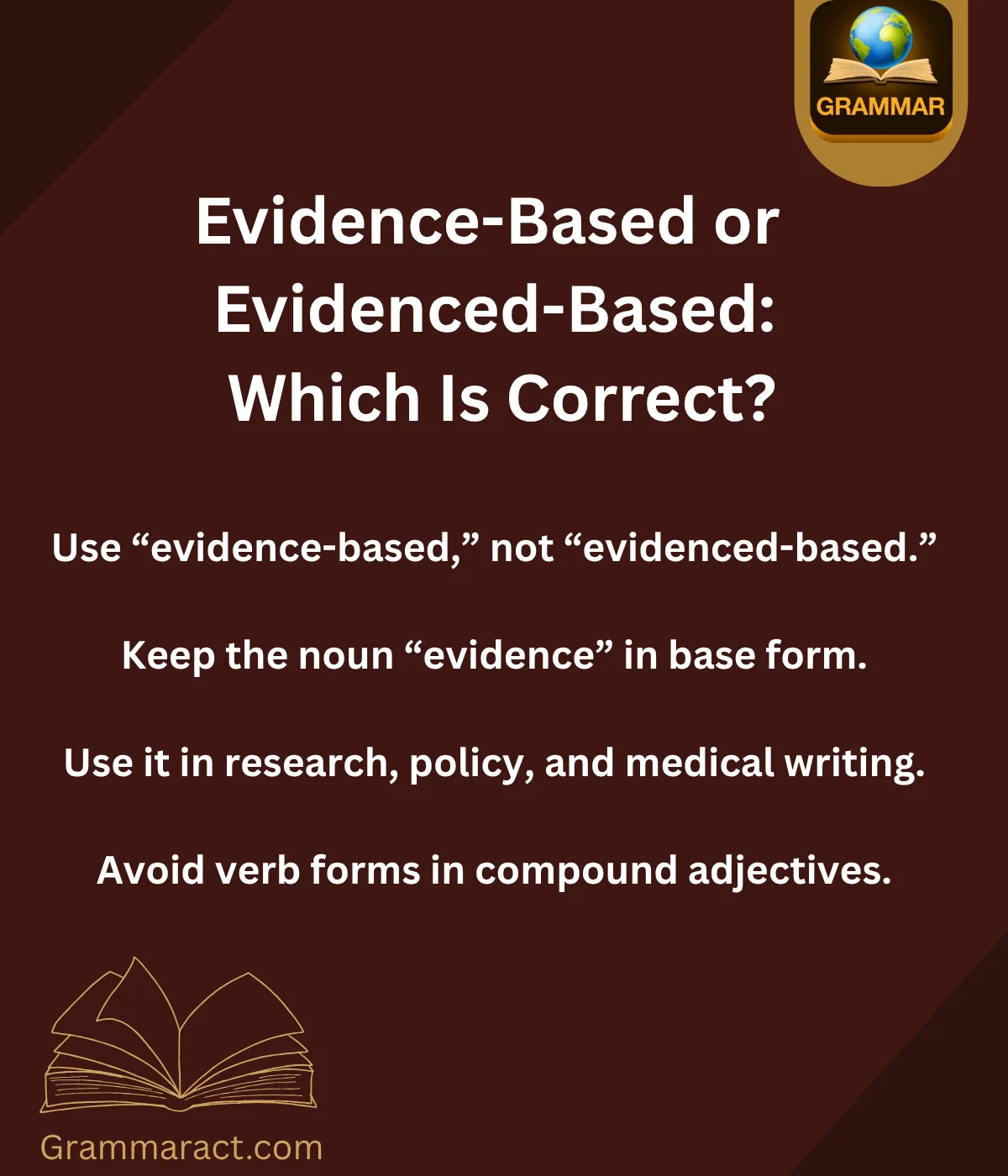
The correct compound adjective is “evidence-based,” not “evidenced-based.” When a noun is used as a modifier before a hyphen, it stays in its base form.
We say “evidence-based medicine,” “evidence-based policy,” and “evidence-based learning.” The modifier is the noun “evidence” — not the verb form “evidenced.”
Real-World Examples of the Correct Form
- ✅ “evidence-based research” — correct
- ❌ “evidenced-based research” — incorrect
- ✅ “evidence-based treatment guidelines” — standard in medical writing
- ✅ “evidence-based decision making” — standard in business and policy writing
How to Use the Word Evident Correctly in a Sentence
Evident as an Adjective: What It Means
“Evident” means clear, plain, or obvious — something perceptible without effort. It describes a state of clarity, not an act of proving.
It pairs with linking verbs like “is,” “was,” or “became,” and with the prepositions “to” or “from” — never with “by.”
Correct Sentence Patterns With Evident
- ✅ “His frustration was evident to everyone in the room.”
- ✅ “The improvement became evident after just two weeks.”
- ✅ “As is evident from the chart, sales peaked in Q3.”
- ❌ “As evident by the results…” — incorrect (missing verb, wrong preposition)
What to Say Instead of This Is Evident
Repeating “this is evident” can make writing feel flat and vague. Try these sharper options:
- “This is clear from…”
- “The data confirms that…”
- “It is plain that…”
- “This is apparent in…”
- “The results show that…”
FAQ: As Evidenced By vs. As Evident By
Is it as evidenced by or as evident by?
It is “as evidenced by.” “Evidenced” is a past participle verb that correctly pairs with “by.” “Evident” is an adjective and cannot be used in this grammatical structure.
Is as evidenced by grammatically correct?
Yes. It is a passive participial clause — grammatically sound and accepted across formal, academic, and professional writing.
How to use as evidenced by in a sentence?
Place it after your claim, followed by the supporting proof. Example: “The campaign performed well, as evidenced by a 50% increase in conversions.”
Is it evidenced in or evidenced by?
Both are correct in different contexts. Use “evidenced by” for an external source or agent, and “evidenced in” when the proof lives within a specific document or data set.
What does as evident mean?
“As evident” alone is incomplete. “Evident” means clear or obvious. The correct phrase using this word is “as is evident from” — not “as evident by.”
What is another way of saying as evidenced by?
Strong alternatives include “as demonstrated by,” “as shown by,” “as indicated by,” and “as confirmed by.” Match the phrase to the formality of your writing.
What to say instead of this is evident?
Try “this is clear from,” “the data confirms,” “it is apparent that,” or “the results show.” These are sharper and more authoritative in professional contexts.
Do you say evidence-based or evidenced-based?
The correct form is “evidence-based.” It uses the noun “evidence” as the compound modifier. “Evidenced-based” is a widespread error that most style guides explicitly reject.
How to use the word evident in a sentence?
“Evident” describes something obvious. Example: “The team’s dedication was evident in every meeting.” Pair it with “is/was/became” and follow with “to” or “from” — never “by.”
Conclusion
The difference between “as evidenced by” and “as evident by” comes down to parts of speech. Verbs pair with “by.” Adjectives do not.
Every time you need to link a claim to proof, reach for “as evidenced by.” It is precise, trusted, and respected in every formal writing context.
One small phrase. One correct form. A big impact on your credibility.

Olivia Smith is the author and admin of GrammarAct, an informational grammar website. She writes clear guides, simple explanations, and helpful lessons to make grammar easy for everyone.