You’re writing an important email and suddenly you stop. Should it be company-wide or companywide?
Both look right. Both appear in real documents. So which one is actually correct?
Here’s the short answer:
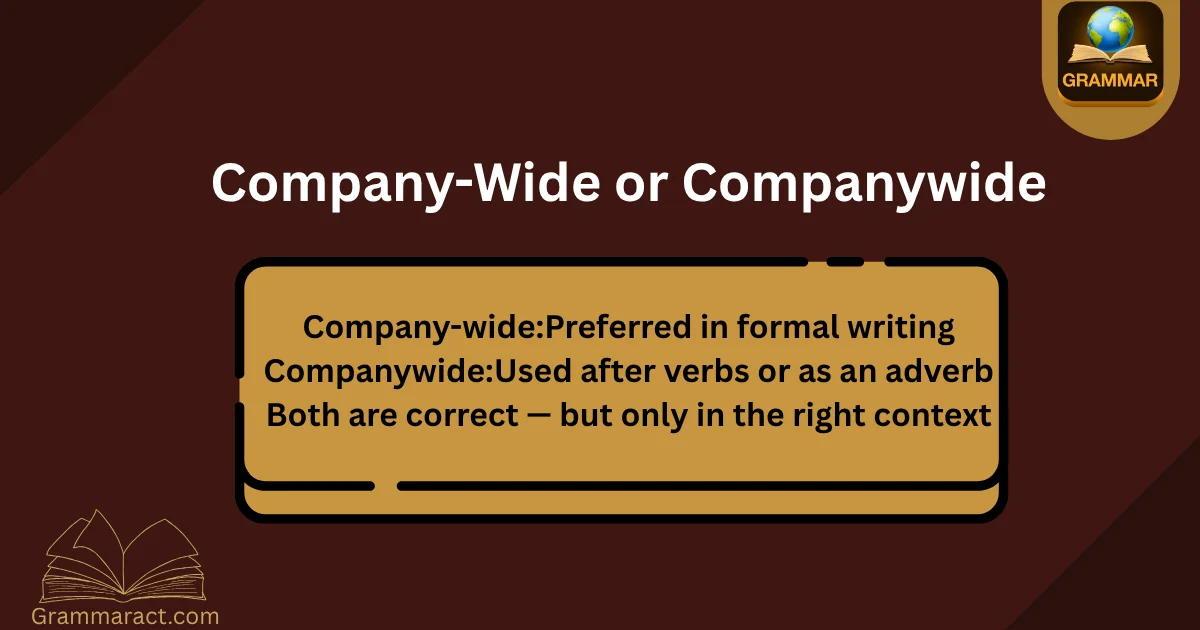
| Form | Usage |
|---|---|
| Company-wide | Preferred in formal writing |
| Companywide | Used after verbs or as an adverb |
| Both are correct — but only in the right context | |
“Company wide” as two separate words is always wrong.
What Do “Company-Wide” and “Companywide” Actually Mean?
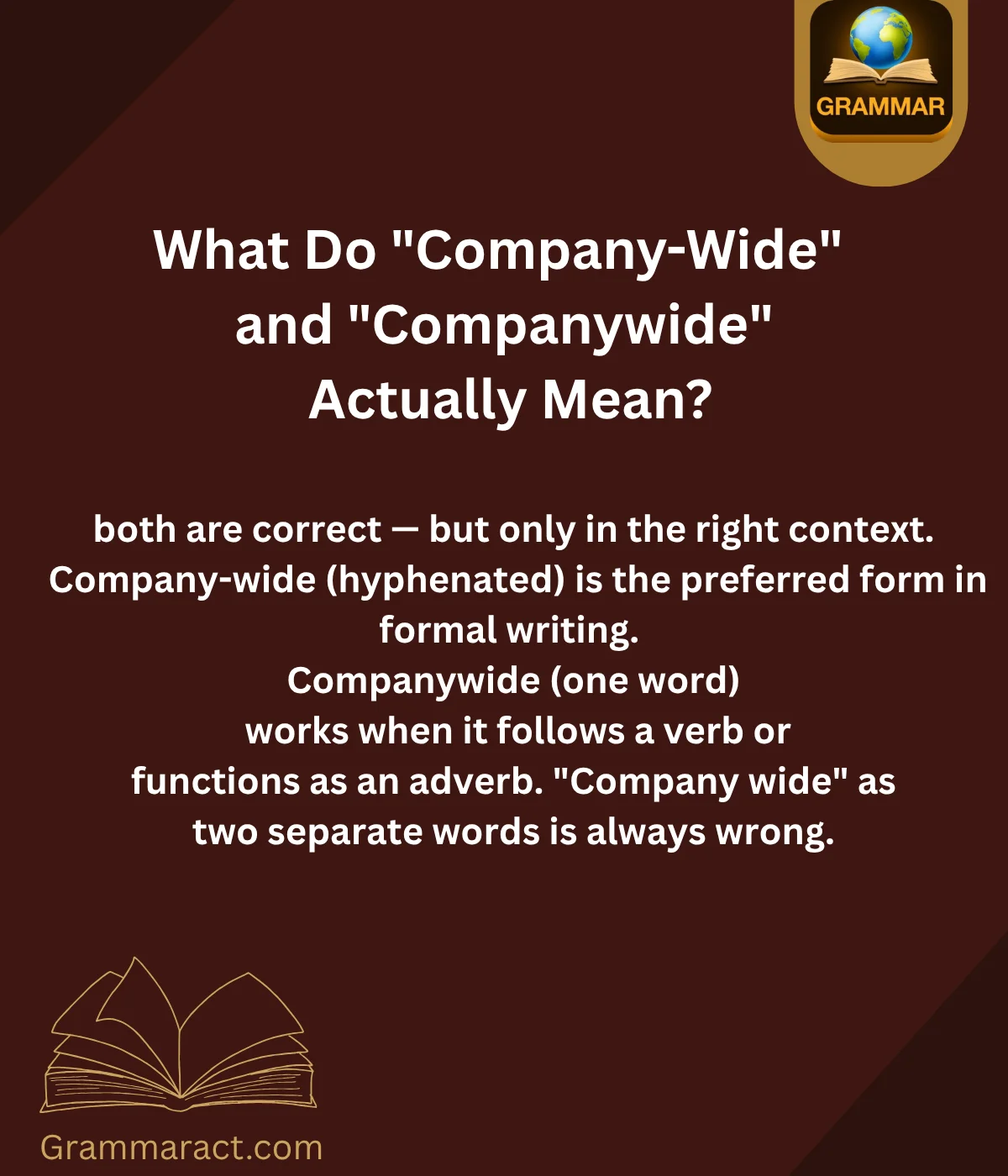
Both terms carry the same meaning. They describe something that affects or applies to an entire organization — every department, every team, every employee.
Companywide refers to an action, policy, or change that spans the full company. Think of phrases like a companywide announcement or a companywide training program.
The word follows the same evolution as nationwide, worldwide, and citywide — all compound words that started hyphenated and later merged into single units.
The Core Grammar Rule – Hyphen or No Hyphen?
The rule comes down to one thing: where the word sits in your sentence.
When company-wide appears before a noun, use the hyphen. It acts as a compound modifier — two words working together to describe a noun.
When the term comes after a verb, drop the hyphen. It functions more like an adverb at that point.
Correct Examples:
- ✅ “The company-wide policy was updated this quarter.”
- ✅ “The new policy applies companywide.
- ✅ “We rolled out the survey companywide last week.
- ❌ “The company wide policy was updated.” ← Always wrong
What Do Major Style Guides Say?
Style guides don’t always agree, but they all point toward one core idea: use a hyphen before a noun, and drop it after a verb.
| Style Guide | Preferred Form | Context / Rule |
|---|---|---|
| AP Stylebook | companywide | One word in all positions |
| Chicago Manual of Style | company-wide | Hyphen before nouns |
| APA Style | company-wide | Hyphen when clarity is needed |
| Merriam-Webster | companywide | Listed as one-word compound |
The AP Stylebook — the go-to guide for corporate and news writing — prefers companywide as one word in all positions.
The Chicago Manual of Style still recommends the hyphen when the word modifies a noun directly.
Bottom line: consistency beats everything. Pick one style and stick with it across your entire document.
Company-Wide or Companywide – Real-World Usage Examples
Major publications and corporations each have their own preference. Here’s how the real world handles it:
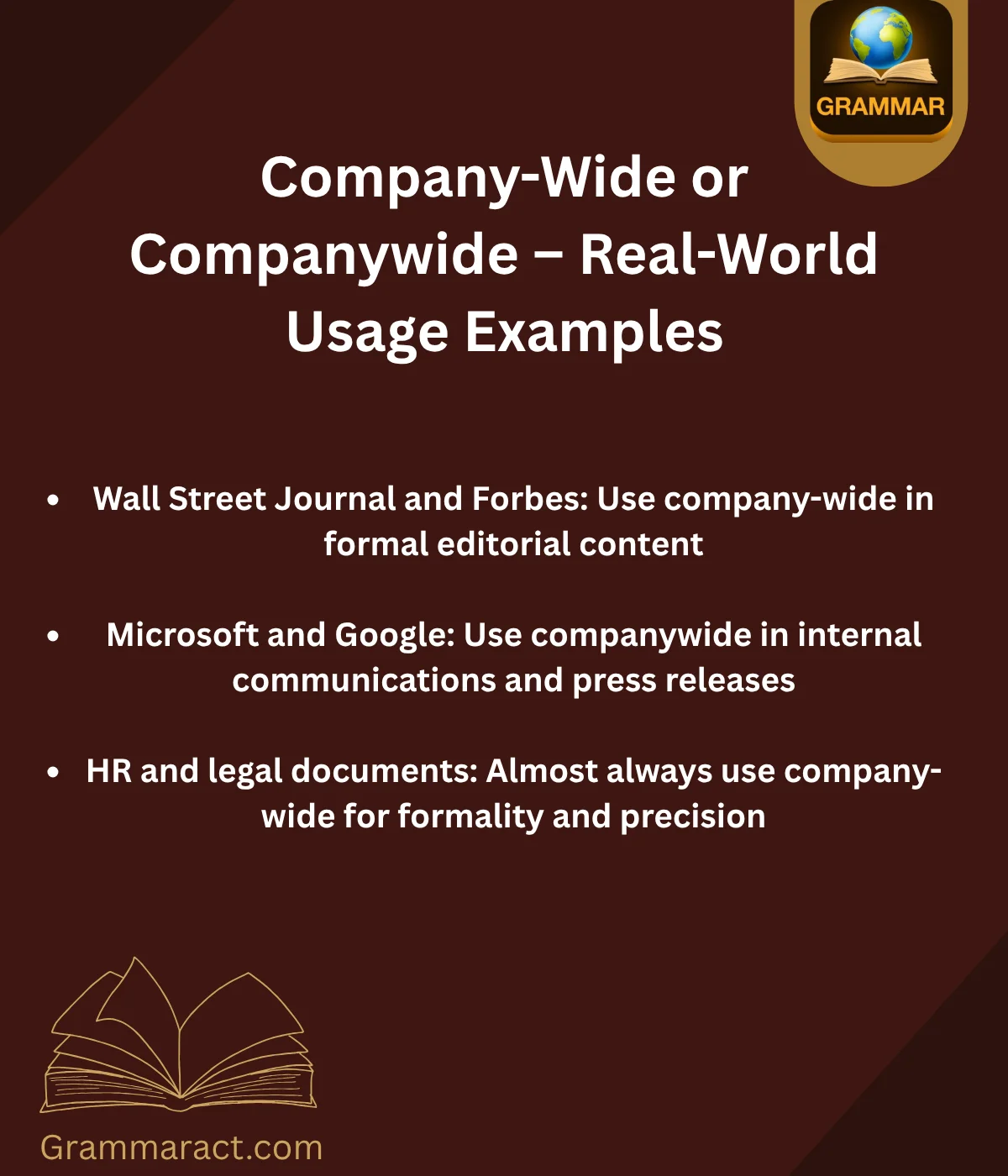
- Wall Street Journal and Forbes: Use company-wide in formal editorial content
- Microsoft and Google: Use companywide in internal communications and press releases
- HR and legal documents: Almost always use company-wide for formality and precision
Practical sentence examples:
- ✅ “The CEO issued a company-wide memo after the merger announcement.
- ✅ “The new benefits package rolls out companywide next month.
- ✅ “We need a company-wide review of all remote-work policies.
- ✅ “Compliance training was completed companywide ahead of schedule.
- ❌ “We launched a company wide initiative.” ← No hyphen and two words — incorrect
Campuswide, Collegewide, and Groupwide – Same Rule Applies
The same hyphen logic applies to other “-wide” compound words that writers frequently get wrong.
| Term | Before a Noun | After a Verb |
|---|---|---|
| campus wide / campuswide | campus-wide initiative | applies campuswide |
| college wide / collegewide | college-wide policy | rolled out collegewide |
| group wide / groupwide | group-wide strategy | adopted groupwide |
| industry wide / industrywide | industry-wide standard | accepted industrywide |
So whether you’re asking is it campuswide or campus-wide, or is it college-wide or collegewide — the answer is always the same. Use a hyphen before a noun. Drop it after a verb. Never write two separate words.
Another Word for Company-Wide – Synonyms and Alternatives
Sometimes you need a different phrase entirely. Here are clean alternatives to company-wide that work in formal and business writing:
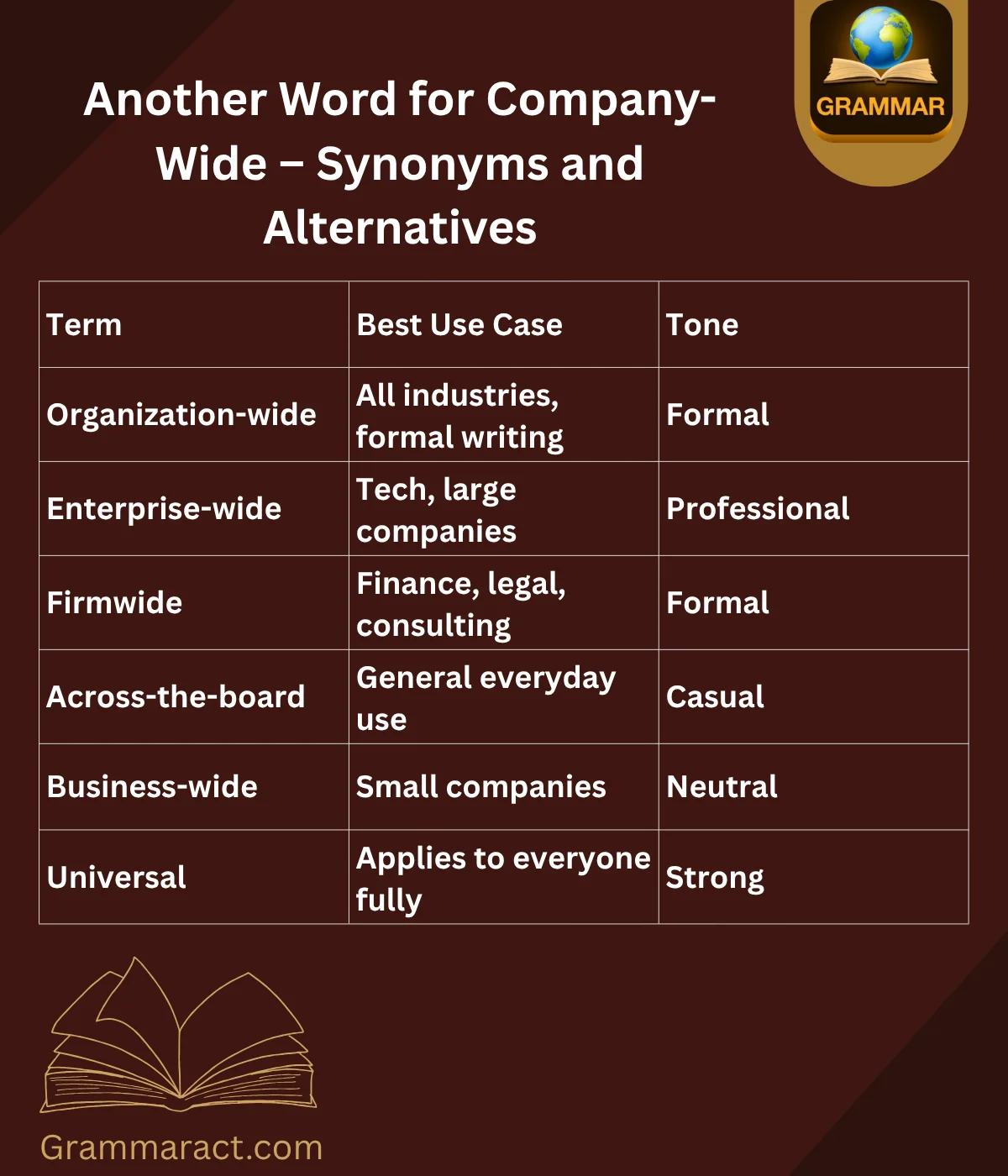
- Organization-wide — formal, works across industries
- Enterprise-wide — common in tech and large corporations
- Firmwide — used in finance, consulting, and legal sectors
- Across-the-board — casual, but widely understood
- Business-wide — straightforward alternative for smaller companies
- Universal — only when the policy truly applies to everyone without exception
Use these when you want to avoid repetition or match your company’s preferred internal communication style.
FAQ – Company-Wide or Companywide
Is it company wide or companywide?
Neither “company wide” (two words) is correct. Use company-wide before a noun or companywide after a verb.
What does “company wide” mean?
“Company wide” as two separate words is grammatically incorrect. Always write it hyphenated or as one word.
Is it campuswide or campus wide?
Use campus-wide before a noun (“campus-wide event”) or campuswide after a verb. “Campus wide” as two words is always wrong.
What does “companywide” mean?
It means something that applies to or affects the entire company — all departments, employees, and teams. It functions as an adjective or adverb.
Is it college wide or collegewide?
Same rule: college-wide before a noun, collegewide after a verb. Two separate words is always incorrect.
Is it groupwide or group wide?
Use group-wide before a noun or groupwide after a verb. “Group wide” as two words is not accepted in standard writing.
What is another word for company-wide?
Strong alternatives include organization-wide, enterprise-wide, firmwide, and across-the-board. Choose based on your industry and tone.
Conclusion
The debate between company-wide vs. companywide isn’t about right or wrong — it’s about position and context.
Use the hyphen before a noun. Drop it when it follows a verb. Never write two separate words.
Most importantly: pick one form and stay consistent throughout your entire document. That consistency is what makes your writing look polished, professional, and credible.

Olivia Smith is the author and admin of GrammarAct, an informational grammar website. She writes clear guides, simple explanations, and helpful lessons to make grammar easy for everyone.