You’re writing an email or a report. You pause. Should it be invision or envision? It’s one of the most common spelling mix-ups in professional writing today.
The answer is simple
|
Envision is the only correct verb in the English language.
Invision is either a misspelling or a brand name — never a standard English word. |
What Do Envision and Invision Actually Mean?
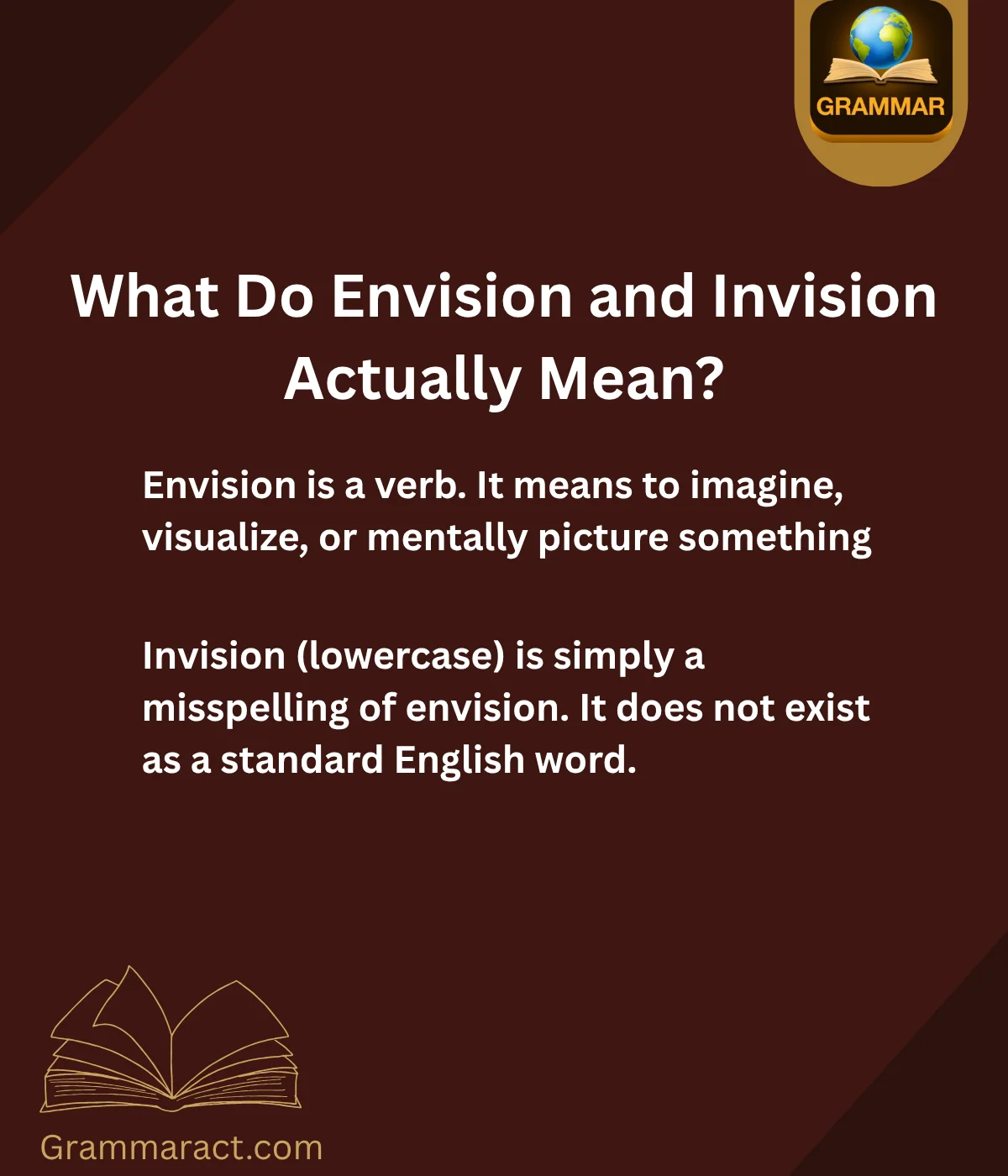
Envision is a verb. It means to imagine, visualize, or mentally picture something — especially a future goal, plan, or situation that hasn’t happened yet.
Invision (lowercase) is simply a misspelling of envision. It does not exist as a standard English word.
InVision (capital I and V) is a proper noun — the name of a digital product design and prototyping platform used by UX teams.
Quick Comparison:
| Word | Correct? | Type | When to Use |
|---|---|---|---|
| Envision | ✅ Yes | Verb | To imagine or mentally picture something |
| Invision | ❌ No | Misspelling | Never — avoid in all writing |
| InVision | ✅ Yes (brand only) | Proper Noun | Only when referring to the design software |
Why Do So Many People Confuse Invision and Envision?
The confusion is real — and it’s not your fault. When spoken aloud, both words sound nearly identical: en-VIZH-uhn. The ear simply can’t tell them apart.
There are a few key reasons this mix-up keeps happening:
- The “in-” prefix is extremely common in English (insight, inspire, involve), so it feels natural.
- The InVision brand is widely used in the tech and design industry, reinforcing the wrong spelling visually.
- Speech-to-text tools and fast typing often auto-generate “invision” without anyone noticing.
- A false belief that one is the UK spelling and the other is the US spelling — this is completely incorrect.
The truth? There is no regional split here. Envision is the accepted standard everywhere. The British counterpart is envisage — not “invision.”
Envision – The Correct Word to Use (With Real Examples)
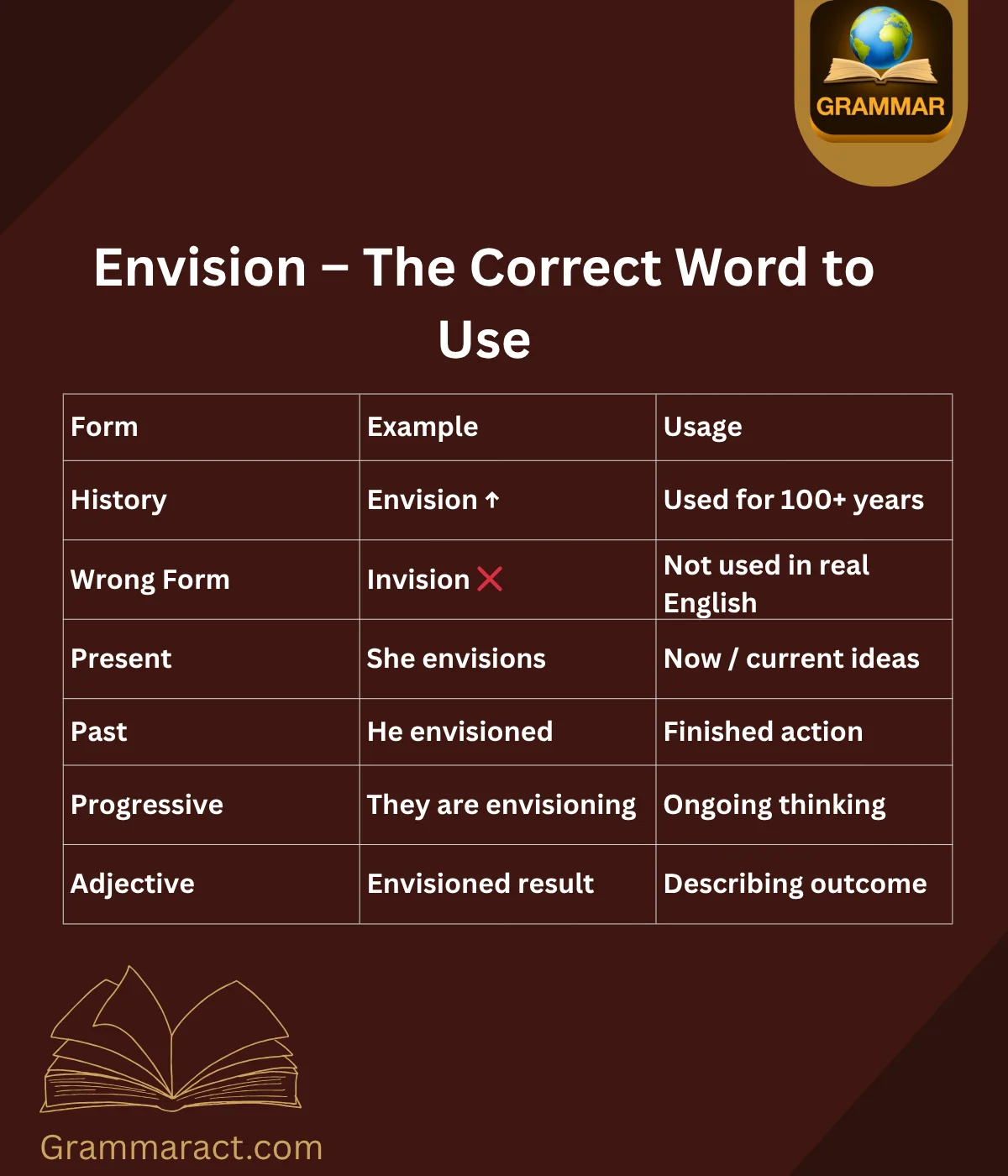
Envision has been part of the English language for well over a century. Google’s Ngram Viewer shows that “invision” has essentially flatlined in published literature since the early 1900s, while “envision” continues to grow in usage.
Here’s how envision works across different verb tenses:
- Present: She envisions a stronger team next quarter.
- Past: He envisioned a city built around clean energy.
- Progressive: They are envisioning a bold product redesign.
- Adjective form: The envisioned outcome exceeded all expectations.
Real-world example sentences:
- The CEO envisioned a future where remote work became the company’s core model.
- As an architect, she envisioned a building that blended nature with modern design.
- Every great athlete envisions their success long before it happens.
- I envisioned a novel set in a reimagined version of ancient Rome.
- Our team envisioned a product that could change how people manage time.
- He couldn’t envision a life without his passion for writing.
Common synonyms for envision include: imagine, visualize, picture, foresee, anticipate, conceive, and envisage (used more in formal or British contexts).
When Is It Correct to Use InVision?
InVision — capitalized exactly that way — is a digital product design and collaboration platform.
Product teams and UX designers use it to build interactive prototypes and share design feedback.
Use it only when referring to the software or company itself. Always keep the brand’s official capitalization: capital I and capital V.
| Term | Meaning | Usage Example |
|---|---|---|
| InVision | Design & collaboration platform used by product teams | Our design team shared the prototype via InVision for review. |
| Correct Use | Only for software/company, keep capital I and V | Please comment on the InVision link before the sprint meeting. |
| Wrong Use ❌ | Not a verb, not standard English word | I invision a better outcome. |
- ✅ “Our design team shared the prototype via InVision for review.”
- ✅ “Please comment on the InVision link before the sprint meeting.”
- ❌ “I invision a better outcome.” — Wrong. Use envision.
Quick rule: Can you replace the word with imagine or picture? Use envision. Referring to the design tool? Use InVision.
Quick Reference – Envision vs. Invision vs. InVision
Everything you need at a glance:
| Scenario | Correct Word |
|---|---|
| Imagining a future goal | envision |
| Business plan or strategy document | envision |
| Design / prototyping software reference | InVision |
| Using “invision” as a verb | Replace with envision |
| Formal UK English writing | consider “envisage” |
Memory trick: The word “verb” doesn’t contain the letter I. Neither does envision. So when you’re using the verb — start with E, not I.
One-line rule: “If you’re imagining it, envision it. If you’re designing it, use InVision.”
How Envision Is Used in Real Life
The word envision shows up constantly in leadership, strategic planning, creative writing, and goal-setting contexts.
It carries a sense of forward-thinking — of deliberately constructing a mental image of something better.
Barack Obama used the word in his book The Audacity of Hope: “We must envision the world not as it is, but as it could be.” That captures the word’s power perfectly.
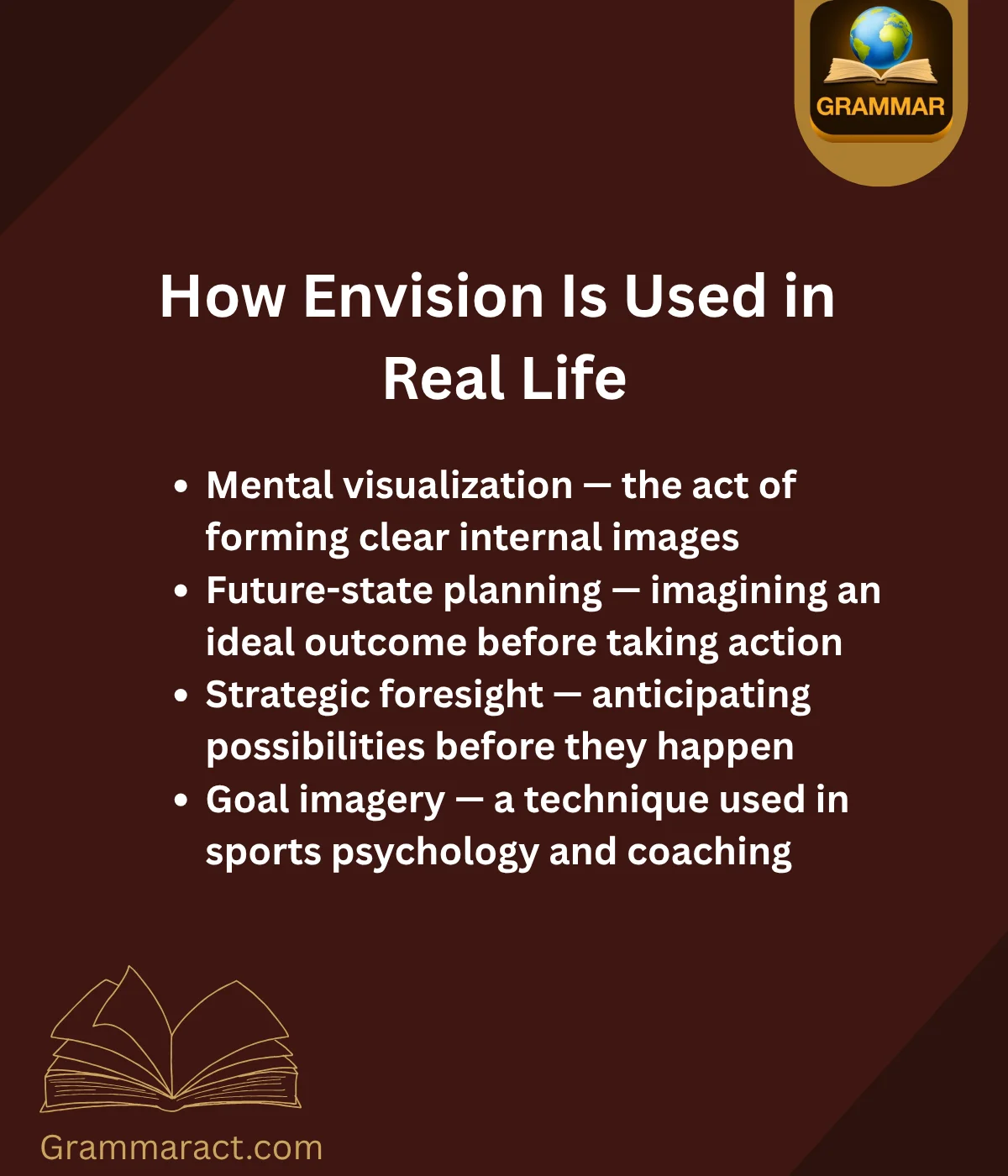
Related terms that often appear alongside envision include:
- Mental visualization — the act of forming clear internal images
- Future-state planning — imagining an ideal outcome before taking action
- Strategic foresight — anticipating possibilities before they happen
- Goal imagery — a technique used in sports psychology and coaching
These concepts are all tightly connected to envision — reinforcing why it’s such a valuable and precise verb in both everyday and professional writing.
Frequently Asked Questions – Invision or Envision
Is it envision or InVision?
Envision is the correct verb for imagination and visualization. InVision is a brand name for a design software platform — use it only when referring to that company or product.
What is Envision 2026?
In 2026, envision remains the standard English verb for expressing foresight, imagination, and mental visualization. Its usage in business, leadership writing, and personal development content continues to rise.
What is the meaning of InVision?
InVision (capital I and V) is a digital product design and prototyping platform used by UX designers and creative teams to build, share, and test interactive design mockups.
Is envision a new word?
No. Envision has existed in the English language for over a hundred years. Historical usage data confirms it was the dominant spelling long before the digital era.
What is meant by InVision?
When someone says “InVision,” they’re referring to the design collaboration software — not any general act of imagining. It is always a proper noun, never a verb.
What is another word for envision?
Strong synonyms include: imagine, visualize, picture, foresee, anticipate, conceive, and envisage. British English writers often prefer envisage for a slightly more formal tone.
What is InVision?
InVision is a digital product design platform that lets teams create interactive prototypes, collaborate on UI/UX designs, and collect real-time feedback before development begins.
What does “envision” mean?
Envision means to form a clear mental image of something — particularly a future possibility, goal, or outcome — before it actually exists or happens.
Do people still use InVision?
Yes. InVision is still actively used by many product teams and UX designers, though platforms like Figma have expanded significantly in the same space in recent years.
Final Verdict: Always Choose Envision
The rule is simple. Use envision every time you mean to imagine, picture, or mentally project a future idea.
Use InVision only when you’re talking about the design software. And never use invision as a verb — it doesn’t exist in standard English.
The next time you sit down to write — whether it’s a business proposal, a creative piece, or a personal goal — envision the outcome you want. You now know exactly how to spell it.

Olivia Smith is the author and admin of GrammarAct, an informational grammar website. She writes clear guides, simple explanations, and helpful lessons to make grammar easy for everyone.