Many people mix up giving and given — and it’s one of the most common grammar mistakes in everyday writing.
Simply put:
| giving is the present participle used in ongoing actions, |
| while given is the past participle used in completed actions or passive constructions |
Both words come from the verb “give,” but they work very differently in a sentence.Knowing the difference helps you write clearly and correctly every time.
What Do “Giving” and “Given” Mean?
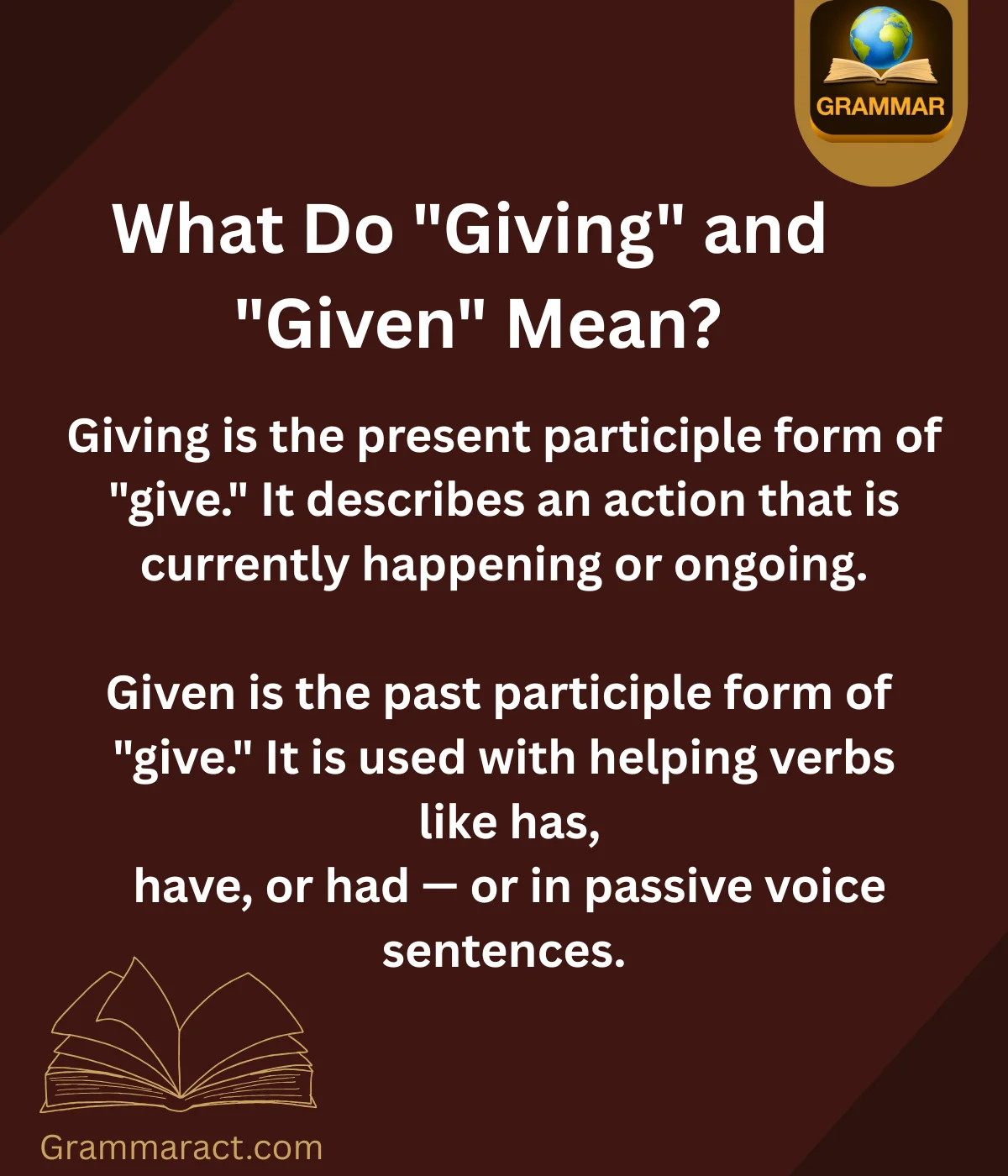
Giving is the present participle form of “give.” It describes an action that is currently happening or ongoing.
Given is the past participle form of “give.” It is used with helping verbs like has, have, or had — or in passive voice sentences.
Quick examples:
- She is giving a speech right now.
- He has given his best effort.
- The award was given to the best student.
| Word | Type | Verb Tense Used |
|---|---|---|
| Giving | Present Participle | Continuous tenses (is giving, was giving) |
| Given | Past Participle | Perfect tenses / Passive voice |
When to Use “Giving” – Rules & Examples
Use giving when an action is still in progress. It always pairs with a be verb like is, are, was, or were.
You can also use giving as a gerund — meaning it acts as a noun in the sentence. It can also describe a person’s character, like “a giving person.”
Example sentences with giving:
- She is giving her notes to the class.
- They were giving out free samples at the store.
- Giving back to the community is important.
- He has always been a giving and kind person.
- We are giving this project our full attention.
When to Use “Given” – Rules & Examples
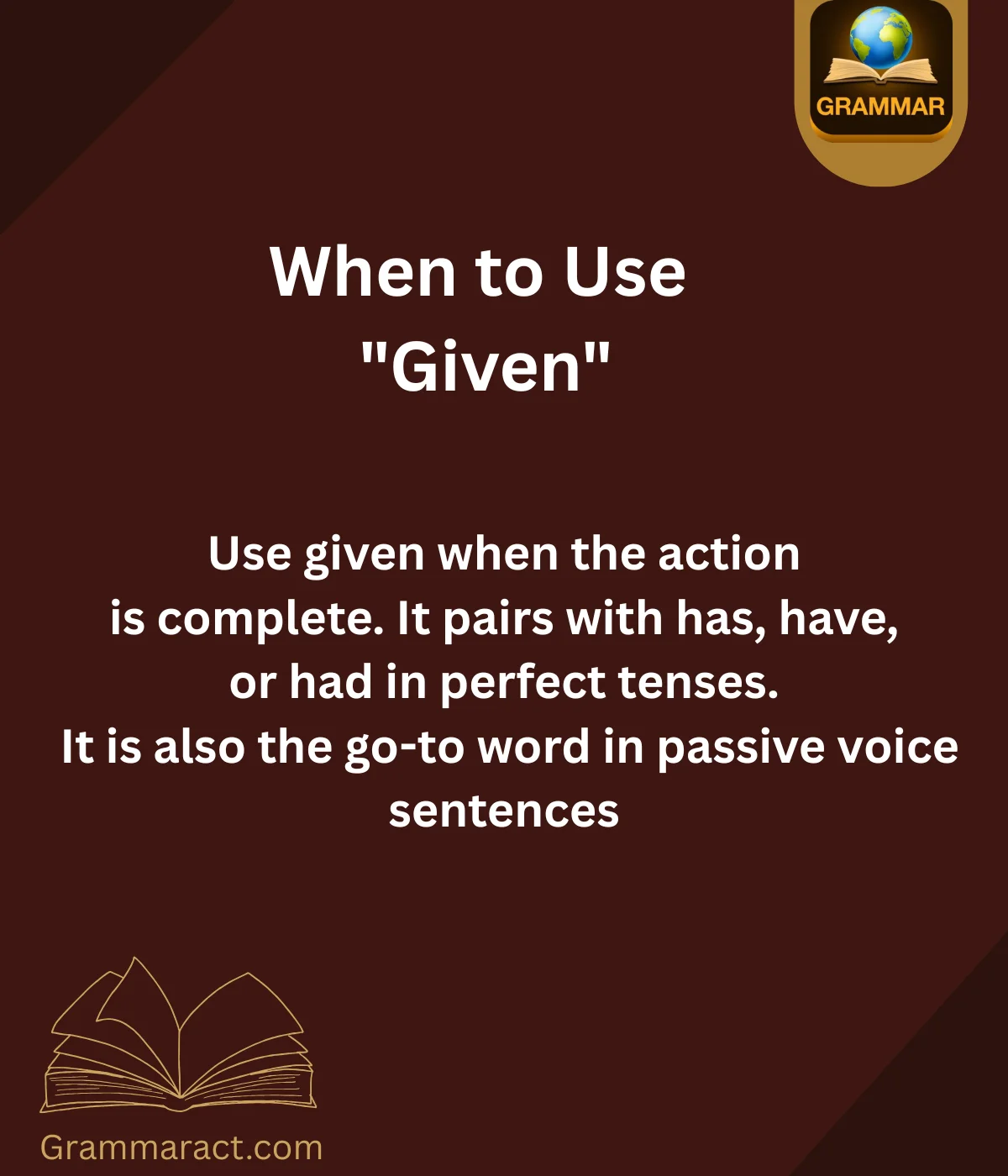
Use given when the action is complete. It pairs with has, have, or had in perfect tenses. It is also the go-to word in passive voice sentences.
Additionally, given can work as a preposition or adjective — meaning ‘considering’ or ‘specific/particular.’
Example sentences with given:
- She has given her resignation letter.
- The homework was given to the students on Monday.
- Given the weather, we canceled the picnic.
- He had given his word before backing out.
- You must arrive at a given time.
- The prize has been given to the winner.
Giving vs Given – Quick Comparison
| Feature | Giving | Given |
|---|---|---|
| Word Type | Present Participle / Gerund / Adjective | Past Participle / Preposition / Adjective |
| Used With | is, are, was, were | has, have, had / passive constructions |
| Tense | Present / Past Continuous | Present / Past Perfect or Passive |
| Example | She is giving a gift. As Adjective: A giving person |
She has given a gift. As Adjective: A given moment As Preposition: Given the situation… |
Here is a clear side-by-side look at giving vs given to help you choose the right word instantly:
Common mistake: “He has giving me the book” — this is wrong. The correct form is “He has given me the book.”
Easy tip: If you can replace the word with ‘considering’ — use given. If the action is still happening — use giving.
Real-Life Example Sentences – Giving and Given
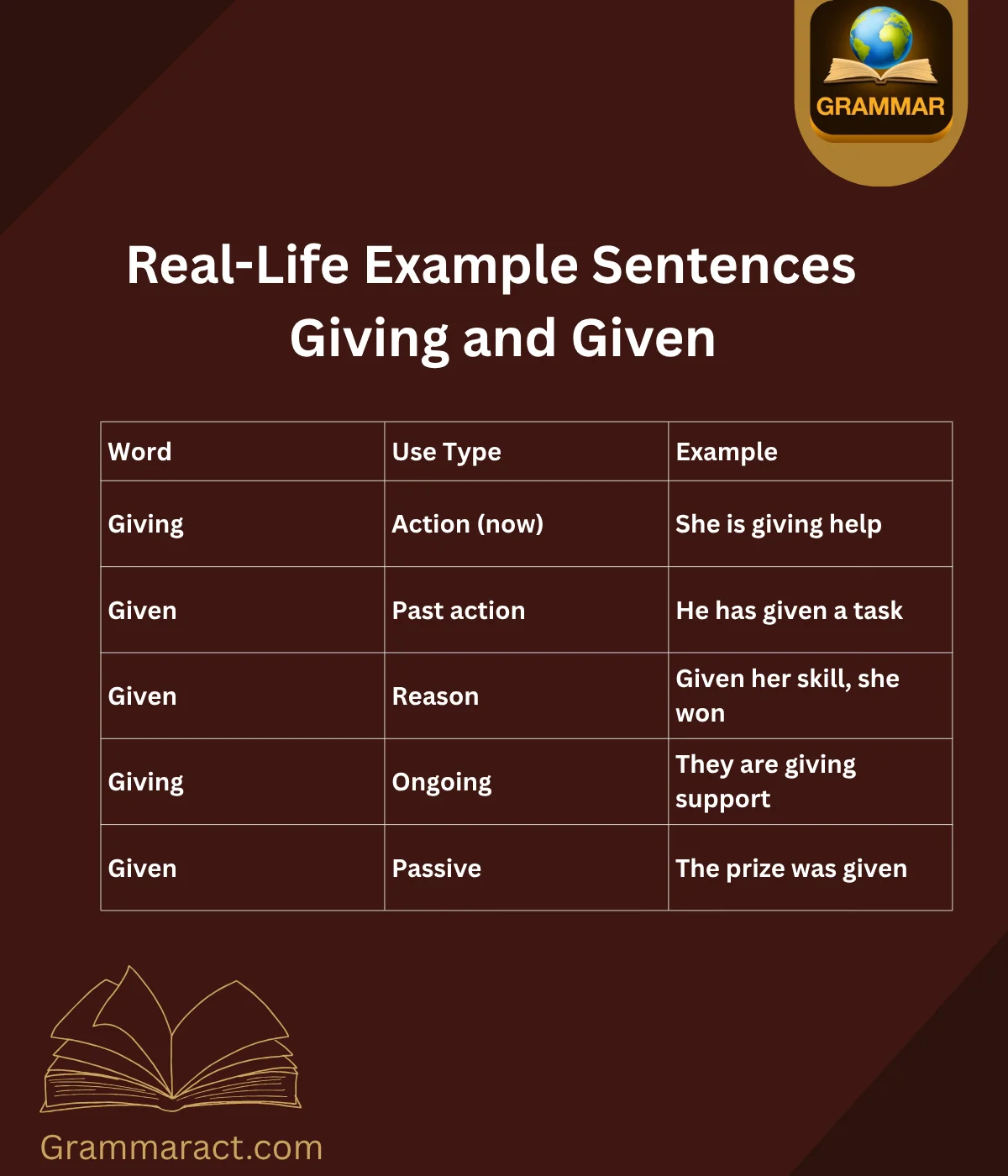
Seeing giving and given in natural sentences makes the difference very clear:
- The teacher is giving an explanation of the new topic.
- My boss has given me a new project to lead.
- Given her experience, she was the best choice for the role.
- They are giving free flu shots at the clinic this week.
- The contract was given to the winning bidder.
- Giving honest feedback is a sign of real respect.
- He had given up on the idea before they even tried.
- Are you giving this your full effort?
- The opportunity was given to anyone who applied on time.
- Given the deadline, we need to start immediately.
FAQs About Giving or Given
When to use giving and given?
Use giving for ongoing actions (She is giving a speech). Use given for completed or passive actions (She has given a speech).
Is it giving you or given you?
It depends on the sentence. “Is giving you” is correct for present continuous (e.g., This is giving you trouble). “Has given you” is correct for perfect tense.
How do you use given in a sentence?
Given works in three ways: with have/has/had (He has given his all), in passive voice (The award was given), and as a preposition (Given the situation, we waited).
When to use the word “given”?
Use given when talking about a completed action, a passive event, or when meaning ‘considering something’ — like in “Given the facts, she was right.”
Is it correct to say “give him him book”?
No. The correct sentence is “Give him his book.” You use “him” as the indirect object and “his” as the possessive adjective before the noun.
Where to use given?
Given is used in perfect tenses (has given), passive voice (was given), as an adjective (a given rule), and as a preposition meaning ‘considering’ (Given the time, let’s hurry).
What is a given example?
A given example means a specific or already-mentioned case. Example: “In any given situation, stay calm” — here, ‘given’ means particular or specific.
What does “given” mean?
“Given” has three meanings: (1) past participle of give, (2) an adjective meaning ‘specific or particular,’ and (3) a preposition meaning ‘considering’ or ‘taking into account.’
Conclusion – Giving or Given, Which One Is Correct?
Both giving and given are correct — they just serve different purposes.
Use giving for actions still in motion and given for actions that are complete, passive, or when you mean ‘considering.’
Once you understand the simple rule — giving = ongoing, given = completed or passive — you will never confuse them again. Practice writing a few of your own sentences and it will become second nature.

Olivia Smith is the author and admin of GrammarAct, an informational grammar website. She writes clear guides, simple explanations, and helpful lessons to make grammar easy for everyone.